

I’m excited to announce that we’ve built an Affordability Dashboard over at the Economic Security Project.
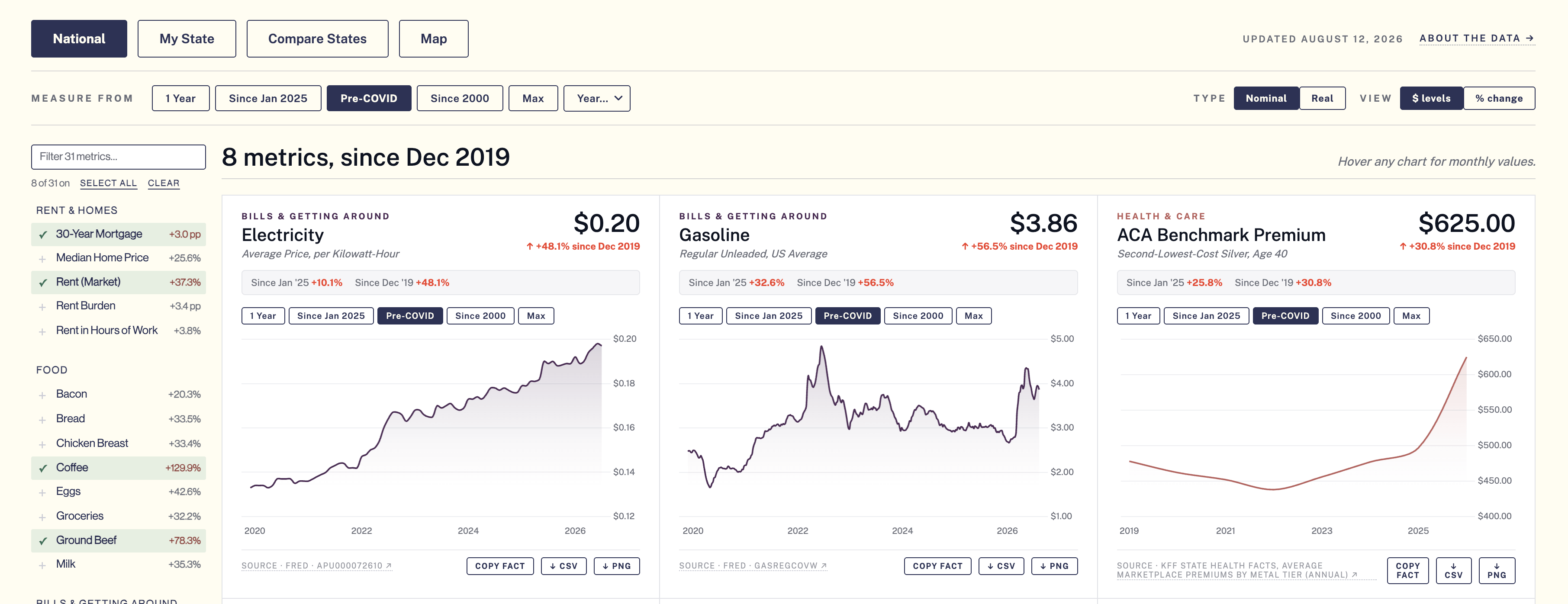
The idea is to pull a lot of publicly available data into one place, both at the national and state level. Whether it’s state-level rent burdens at Census or the BLS’s national average food prices for things like coffee and beef, there’s a lot to fit into a dashboard. It’s something I’ve been wanting to do for a while, and with vibe coding we finally got it built. There are so many data nuggets I’ve learned over the years, and I want to share all my nuggets with you. I hope you’ll check it out.
There are tabs for national and state, and also a state map where you can click to generate state-level data. You can click on any of the charts to download the underlying CSV, or grab an image to use on social media. If there’s data you think we can add, please let me know in the comments below!
I also want to use this to make a few points about the Vibecession debate, which flared up again when the conservative movement cracked apart over $20 burritos. Matt Yglesias had a good writeup here.


I’ve written before about affordability. But I want to reframe this a bit. Rather than burritos, I think we can show the affordability issue with two graphics.
Let’s start with health care. This is the ACA benchmark premium from KFF, for Maine, North Carolina, Michigan, and Texas:
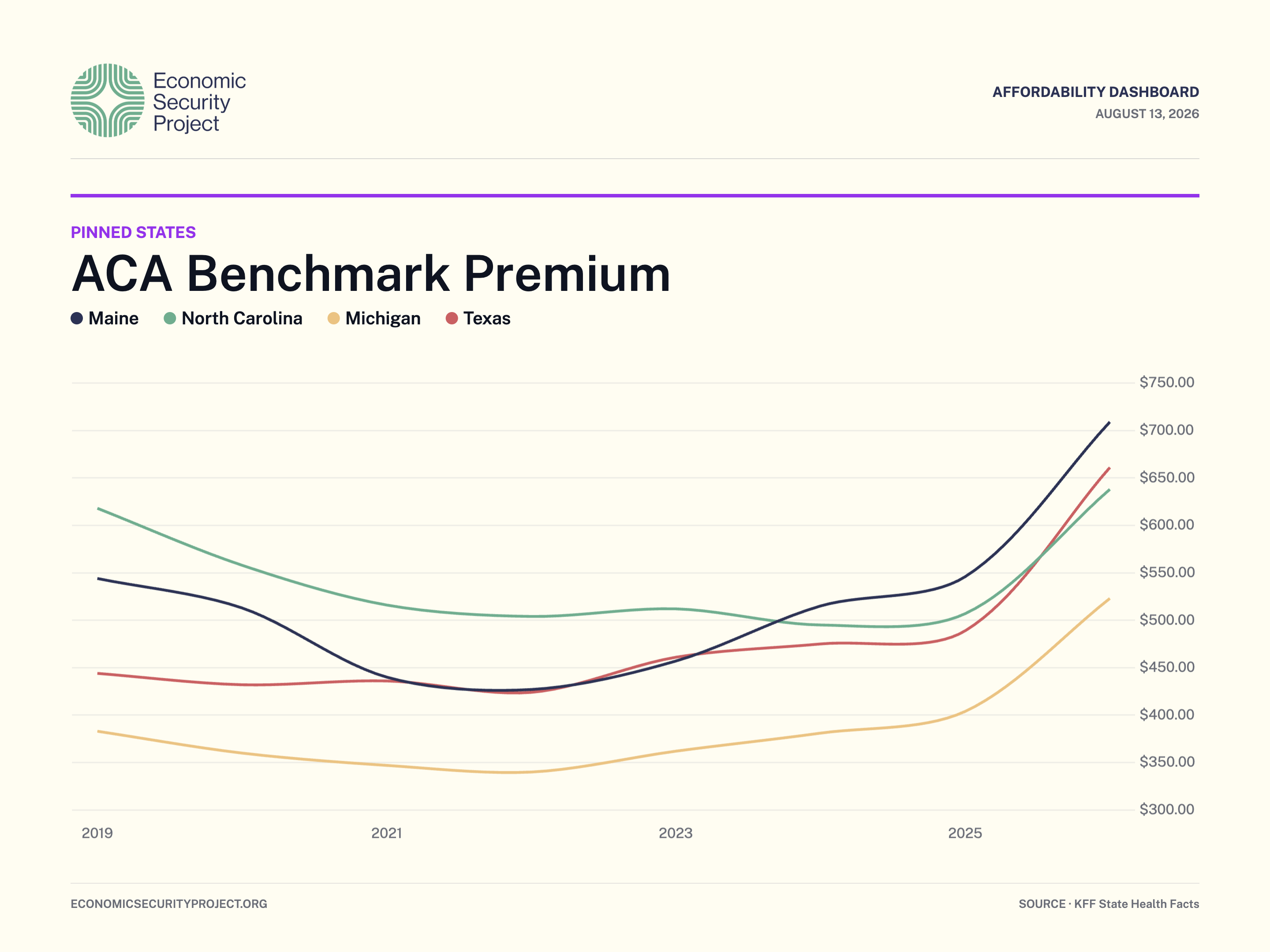
Premiums skyrocketed in 2026 for all of them, after having been relatively flat or even declining since 2019.
Let’s do the same for the number of hours someone at the average wage nationally and in those states has to work to afford average rent there:
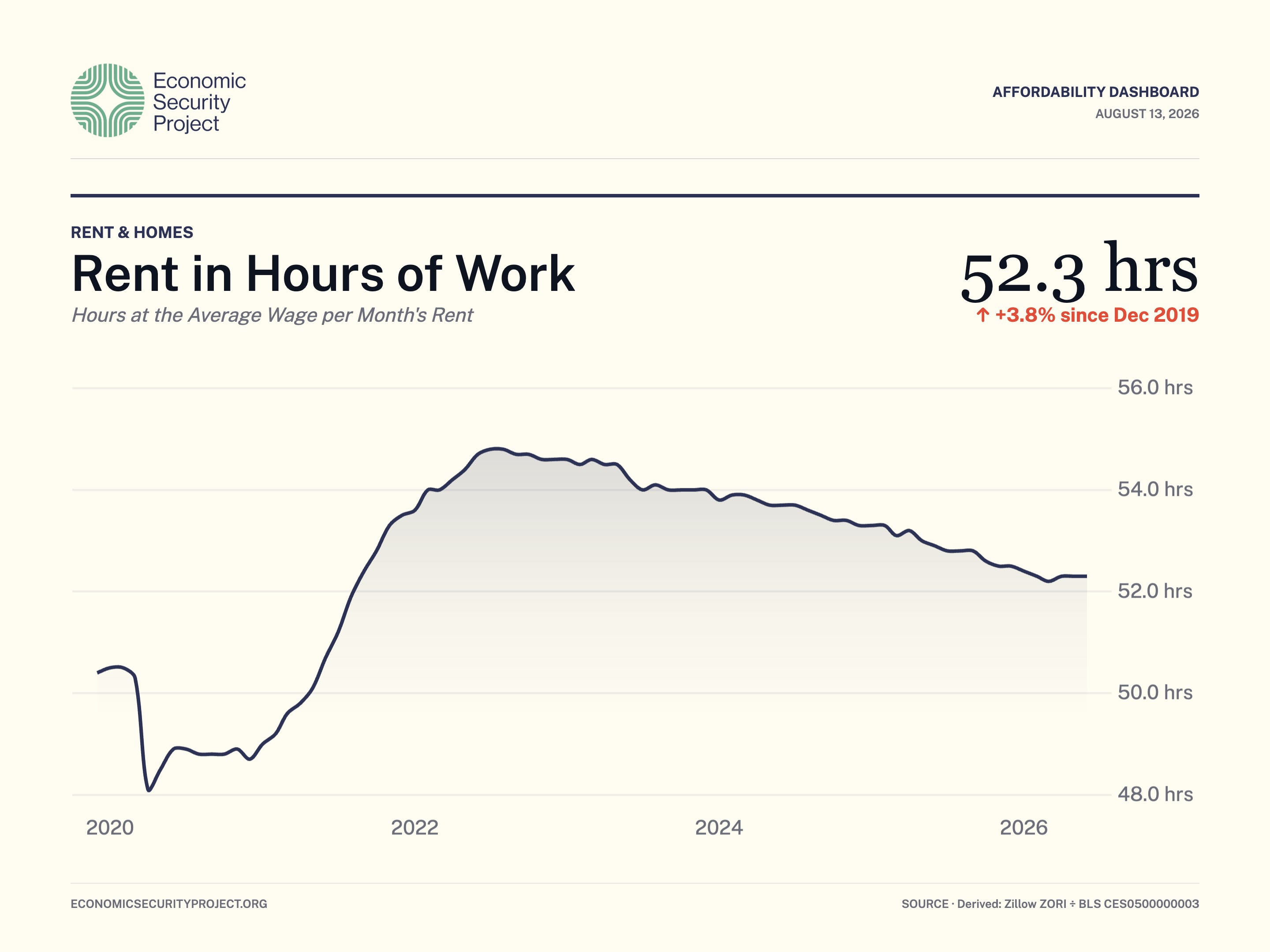
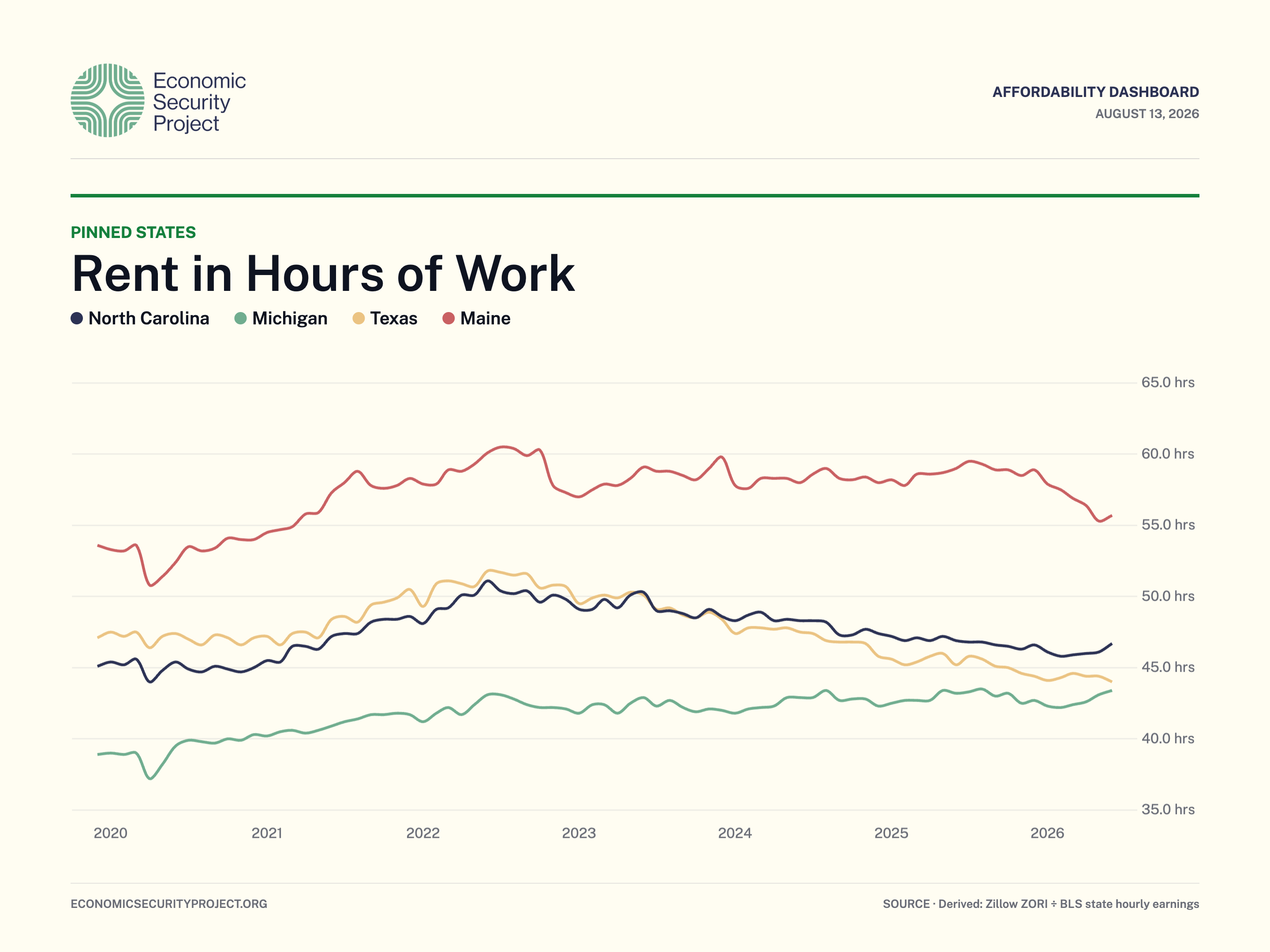
As you can see, this measure remains elevated, though it seems to be slowly converging back. I like this measure of housing costs because we can strip CPI out as an inflation measure, which saves us the awkwardness of deflating shelter by an index that is 35 percent shelter.
A Different Affordability Crisis
People often talk about the affordability crisis as a general price level problem. But in my experience talking with people and watching the polling, it tends to be about three things: health care, housing, and food. (Edit: energy too, which also won’t solve itself.)
I want to make a few observations here, all of which suggest we should move our unit of affordability analysis away from macro variables and toward micro ones. There are macroeconomic risks: inflation is higher than target, the labor market is frozen, and young people’s unemployment is well above where it should be at this point in the cycle. But I think the people focused on core cost concerns are the ones describing the problem correctly. (If you read me regularly, you know how much I love macro, so it pains me to turn this way.)
Health care, housing, and food are an important affordability story here. First, aggregate inflation numbers don’t capture health care and housing the way consumers experience them. Take the Consumer Price Index, which is what we use to judge real wages. Health insurance there is priced indirectly, through insurers’ retained earnings. Homeowners’ costs are imputed through owners’ equivalent rent. And the rent index tracks the average rent paid across all tenants. The two costs hammering people in the graphics above simply do not show up in inflation measures, at least not in the short run, the way voters expect.
Food shows a different version of the same gap. As we’ve discussed in the DoorDash discourse here before, people, including young people, are spending less of their food budget on food prepared away from home, whether that’s delivery or restaurants. Instead they’re shifting toward groceries and food prepared at home, a shift the political class hasn’t absorbed. So it is possible the actual vibes people are facing just aren’t captured in the aggregate macroeconomic data.
Second, the cuts congressional Republicans and the Trump administration have executed around health care and food won’t show up in inflation measures; they’ll instead show up in incomes. The expiration of the enhanced premium tax credits and the major cuts to SNAP are treated in the national accounts as incomes (government transfers), not as price indexes. So some of the tools we’ve been using to determine the vibes (e.g. real wages) just won’t be as useful for what comes next.
Third, there were real political choices here. Mass deportation and tariffs raise what it costs to build, and higher interest rates raise what it costs to finance. Republicans have chosen to cut more than a trillion dollars from health care and food security to pay for high-end tax cuts. These are all one-for-one hits to affordability in the sense people care about.
I actually don’t think the focus on the University of Michigan consumer sentiment index, which has hit all-time lows, has been useful here. The Fed focuses on it as a forecasting tool, on the theory that if sentiment falls, spending falls, so the Fed can get ahead of it. It’s not a political barometer. That relationship between sentiment and spending broke down after 2020 and hasn’t come back. The methodology also moved online in 2024, which, estimates say, further lowered readings. Partisanship is probably pulling it further outside its historical relationship too. But we know people are angry independent of this.
The Political Questions
There are (at least) two political arguments against treating affordability as a central political and economic challenge right now. The first is that there’s nothing to be done about it: you can’t lower the overall price level without a depression. The second, less often stated, is that the issue could evaporate. Maybe one day soon people turn a corner and decide the economy is fine; burritos being $20 is just normal again.
For the first, if the problem is less about the overall price level and more about specific sectors, there are ways to address it. The general price level is here to stay. But the cost of health care doesn’t have to be, because coverage is a policy variable: the uninsured rate went down under Obama and Biden, and it’s going to go up under the second Trump administration. The insured rate is too important to Democratic policymakers and too visible to ignore. And no matter what comes after Trump, the GOP is just structurally incapable of finding a way to address it.
For the second, I doubt it. There’s simply no way health care, housing, and basic income security get solved in the next few years, and health care is certainly going to get worse. I had wondered whether they’d kick the can on the Medicaid cuts, given how much they would nuke the ascendant coalition Trump has worked so hard to build. Smarter Republicans like Senator Hawley argued against them on these grounds. But given the interim final rule CMS issued in June, it’s clear the Republicans are going for a very aggressive implementation, and lots of cross-pressured voters are going to get screwed.
Again, it’s not been helpful to debate whether sentiment is at an all-time low again after drifting higher in 2024. We do know an increasing number of people think the country is on the wrong track, and an increasing number of people put economic issues at the top of their concerns. This is the economic challenge of the moment, and it’s easy to see why if you have the right dashboard.
Thanks for the ESP dashboard. It pinpoints the main culprits in Americans' malaise re the economy - and Trump's economic policies - working against them.