

Let’s play a game. Below is a list of 13 inflation measures. I want you to guess two of them. Specifically I want you to guess the two inflation metrics Kevin Warsh said were his preferred measures during his Senate nomination hearing last week.
If you’ve followed inflation over the past 5 years you may be familiar with some of these. They have come up at some point to prove or disprove your favorite theory of why inflation has behaved the way it has. They all have links to their actual sources.
Now try to guess which two Warsh pointed to as being the best ones for right now. It’s ok if you don’t know much about inflation or economics, I think you can make an educated guess which are the two.
If you guessed the lowest two, the two “trimmed” ones, the ones that said inflation was the lowest under Donald Trump, congratulations. You got it right. Specifically, Warsh said the following during his testimony (my bold):
Senator Catherine Cortez Masto: So some Federal Reserve officials have said that this excess is due to tariffs. Do you agree with that?
Kevin Warsh: Senator, I don’t. […] the Fed needs to do, is to try to use our new understanding and new data sources to see what’s really the inflation rate in the economy. We used to use Core PCE, Core measures, so we’d exclude food and energy, because it was sort of a rough swag as to what was going on. We don’t have to do a rough swag anymore. What I’m most interested in is, what’s the underlying inflation rate? Not what’s the one time change in prices because of a change in geopolitics or a change in beef, but what’s the underlying generalized change in prices in the economy?
My broad sense is that these inflation risks and the inflation damage the last several years is improving somewhat. It has improved somewhat in the last year. The measures I prefer are looking at things that are called trimmed averages, where we take out all of the tail risks, all of the one-off items, and we ask ourselves whether the generalized change in prices is having second order effects on the economy. Again, they’re not where they should be, but I think that the trend is quite favorable.
I’ve tried to approach the Warsh nomination with an open mind. After all, a wide bipartisan range of people affiliated with Harvard University said he was a good choice.
I understand the liberal worry that Warsh is a sock puppet for President Trump’s ambitions to control the monetary and financial system. I worry about that too. There is something bleak yet familiar about watching someone so rich they can’t disclose all their wealth or plans for divesting thinking they’ll win out against Trump, that they’ll be the one who doesn’t get bitten by the snake they are supporting.
I also don’t take any comfort that the Federal Reserve board would contain him or Trump’s influence. As Bharat Ramamurti discussed, Fed chairs generally get their way. They control the staff, set the agenda, put the first formal policy proposal on the table, and set the tone at the press conferences.
But, and there’s no polite way to say this, I’m more worried that he’s just not up for this moment. This is going to be a very difficult time for the central bank, and nothing Warsh has said has given me much confidence in his abilities. He says a lot of stuff that no doubt works well in the circles he rolls in, but I don’t think it stands up well to anyone thinking seriously about the topics.
The way he discusses the Fed’s balance sheet, for instance, doesn’t convey that he’s thought hard about the tradeoffs. It’s even more apparent when he argues AI productivity would lower interest rates, seemingly unaware of the more obvious counterargument, like Krugman notes, that it would raise them. It all seems shallow.
Trimmed Mean Was a Disaster Measure
Warsh’s quote above continues this. I genuinely mean this in a non-partisan way, the worst lesson you could have taken from the last six years is that trimmed mean measures have some special signal other measures lack. During the inflation wave they consistently performed worse in both directions, leaving many smart researchers positioned the wrong way at the wrong time throughout the whole inflation saga.
Looking at the graphic above, you can see how much trimmed mean inflation trailed overall inflation during the initial inflation wave. Various trimmed and related measures made people underestimate in 2021 how high and widespread inflation would become in 2022, especially expanding to services. Trimmed measures moving up in 2022 also caused smart people to think a recession was necessary to bring down inflation. Instead, we had the soft landing, where GDP went up ~2.8% a year during the two years where inflation fell four percentage points, making traditional measures like the sacrifice ratio have the wrong sign.
I’m going to mention some names here, but I want to be clear I screwed this up more than most. But take Federal Reserve Chair Jay Powell himself. At Jackson Hole in August 2021, when inflation picked up but was not yet widespread, he pointed to “trimmed mean measures […] generally show inflation at or close to our 2 percent longer-run objective.” Yet six months later, the February 2022 Monetary Policy Report used the very same Dallas trimmed mean to argue that inflation was skyrocketing.
You can see an exaggerated version of this among academics. In a December 2021 IMF paper, Laurence Ball and co-authors held up the Cleveland weighted median and Dallas trimmed mean as the measures that had stayed smooth through the pandemic to imply that underlying inflation was still contained. But by the time of Ball’s September 2022 Brookings paper, built on the Cleveland weighted median (an extreme version of trimmed mean), Ball had flipped to the opposite side, arguing that the trimmed measures showed the Fed would need to push unemployment “far higher” to get inflation back to target, and either inflation would stay high or the country was headed for “a substantial economic slowdown.”
As Preston Mui of Employ America later noted, the Brookings event discussing the 2022 Ball paper was a venue for many to conclude that a higher trimmed mean inflation necessarily meant a recession was required to bring down overall inflation rates.1 Jason Furman wrote a Wall Street Journal piece on the paper, calling it “the scariest economics paper of 2022” and arguing an elevated trimmed measure meant “we may need to tolerate unemployment of 6.5% for two years” to bring inflation down. Thankfully the soft landing didn’t require any of it.
My own theory of the inflation wave is that there were several overlapping shocks, especially to the composition of spending, to working remotely, and key inputs like semiconductors as well as commodities following the war in Ukraine. That pulled up many prices, and because we live in a Keynesian world full of rigidities, other prices did not fall. Then relative prices were out of sync, so that pulled up other lagging prices, moving the distribution of items to line up. You can follow this logic with microfounded models as in Lorenzoni and Werning (2023), ironically the BPEA paper of the following year.
This is even more important as the divergence picks up again, as more is being excluded in these tails. The Dallas Fed did a deep dive into what their methodology finds in this moment. After replicating for a future post, I’m reading that in recent months it looks like service inflation is picking up, something we’ve been covering, but is being hidden by the trimming method. So we’re back to where we started: what exactly is going on at this moment?
These kinds of stories won't be understood through just looking at the central distribution of inflation. These overlapping shocks generate the misleading trimmed-mean signal that fooled analysts during the actual inflation wave. Figuring this out requires wisdom and judgment.
Rewatching the video of that 2022 Brookings Papers event, with all the economists calling for a major recession as soon as possible, there’s a funny moment where, as a result of multiple cameras, you can watch Claudia Sahm’s reaction in real time from her back row to Frederic Mishkin, of financial (in)stability in Iceland fame, saying that “bottom line is that the recession is probably going to be a serious recession” to bring inflation down.
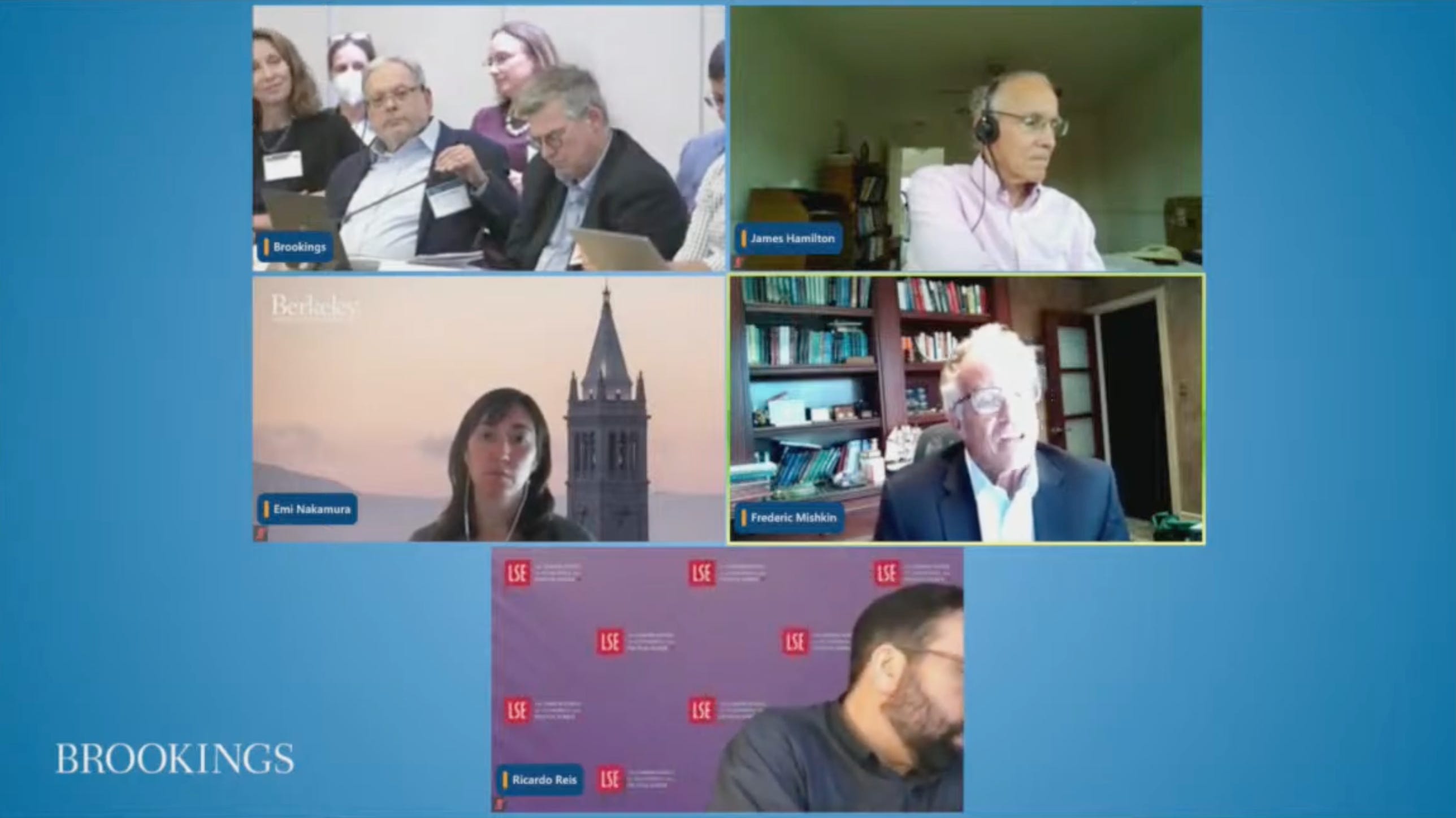
Is it an epic eye-roll? I’ll leave you to judge. Claudia was one of the smartest people on this inflation wave, so subscribe to her Substack. Hi Claudia! 👋
Another great one, MK. I found this recent note from the Dallas Fed to also be a useful take on when to up- and down-weight the trimmed mean: https://www.dallasfed.org/research/economics/2026/0416 (Answer: what the dist of prices is more skewed, it tells you less about where inflation is headed, consistent with your insights here).
But I'd like you to unpack your "...own theory of the inflation wave" a bit more. I agree with the dynamics that you and L/W describe but it seems simpler and clearer to simply point out that strong demand collided with constrained supply. As those two edges of the scissors normalized, inflation receded.
Nuances abound, of course, most notably how consumer preferences shifted towards goods demands at the very time they were unusually hard to move. And we can argue how much fiscal contributed to demand. I'm really not sure about the role wage growth plays. Alan Blinder's adage is stuck in my head on this one: prices cause wages and wages cause prices.