

In response to my recent post on women gaining 101% of net payroll jobs under the Trump administration, commentators argued that this was largely about immigration, about native-born male workers taking jobs formerly held by deported immigrants and showing up as no net-new jobs. This turned out to be a total fabrication, it never happened, it’s fiction (see Hypothesis 3 below).
But it did make me realize that it’s been a little bit since I took a dive into the immigration debates. I’m nervous doing this because I know the Trump administration are not exactly “preponderance of the evidence” people. If they find one thing, one way to pitch the data favorable to them, they’ll run with it. Indeed, they spent a lot of 2025 arguing off the CPS raw levels, even though Jed Kolko spent a lot of time politely and ultimately correctly explaining why that was not a good idea. What are the chances we shoot the moon and find that all ten of our different hypotheses turn out to go against the restrictionist case?
Pretty good, actually. I crank through ten indicators where we might expect to see that payoff. But there is no employment or wage-growth boom for native-born workers in this data. I can’t find it.
We’re going to move pretty fast through this. There’s a GitHub here where you can go ahead and ask your AI to download it and check it yourself. As we go, let’s channel our inner Jonathan Frakes on Beyond Belief: Fact or Fiction, telling us none of it ever happened. It’s a fake.
Hypothesis 1: Native-born unemployment would fall.
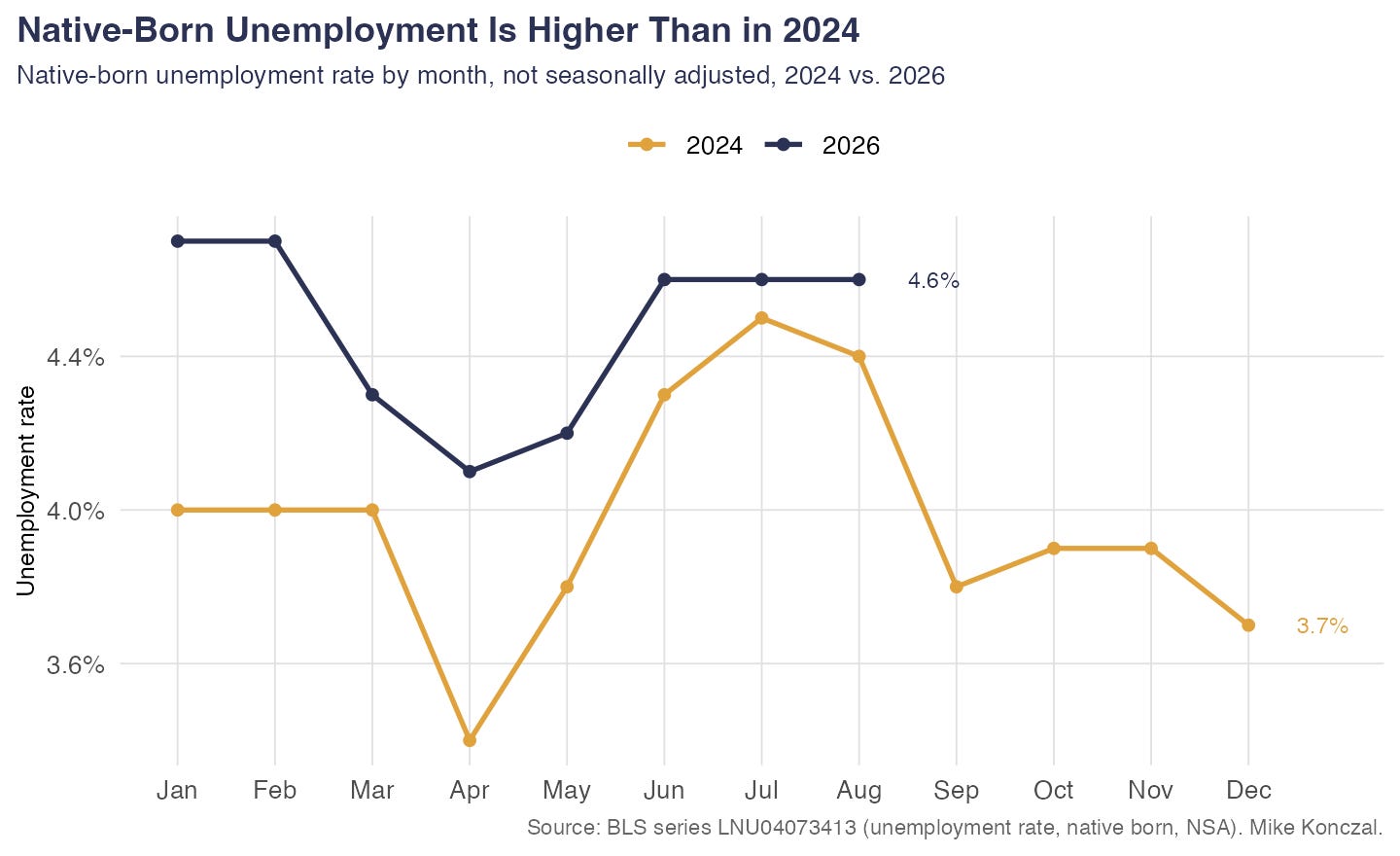
It never happened. It’s higher instead. (Not seasonally adjusted, published BLS series.)
Hypothesis 2: Prime-age employment would rise for native-born workers.
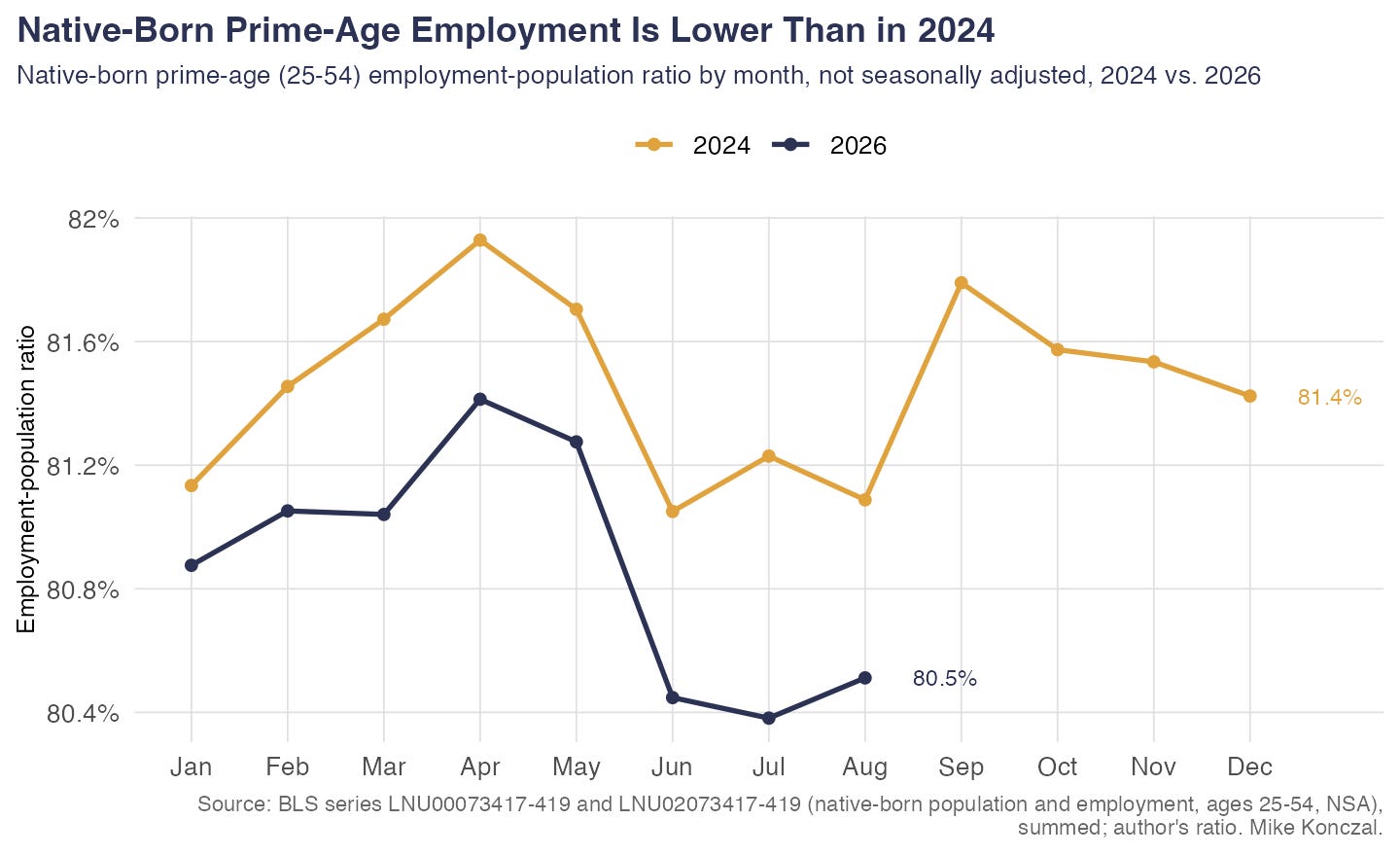
Not this time. Instead, it is lower. (Not seasonally adjusted, aggregated published BLS categories.)
Hypothesis 3: Prime-age employment would rise for native-born male workers. The native-born prime-age employment rate is lower, but maybe men did better. This was the response to the gender split mentioned at the start. During the 2024 election, in response to a question about deportations, J.D. Vance said, “You would take, let’s say for example, the seven million prime-age men who have dropped out of the labor force” and “re-engage folks into the American labor market.” He later noted, “we have seven million—just men, not even women, just men—who have completely dropped out of the labor force.” Has that translated into an employment boom?
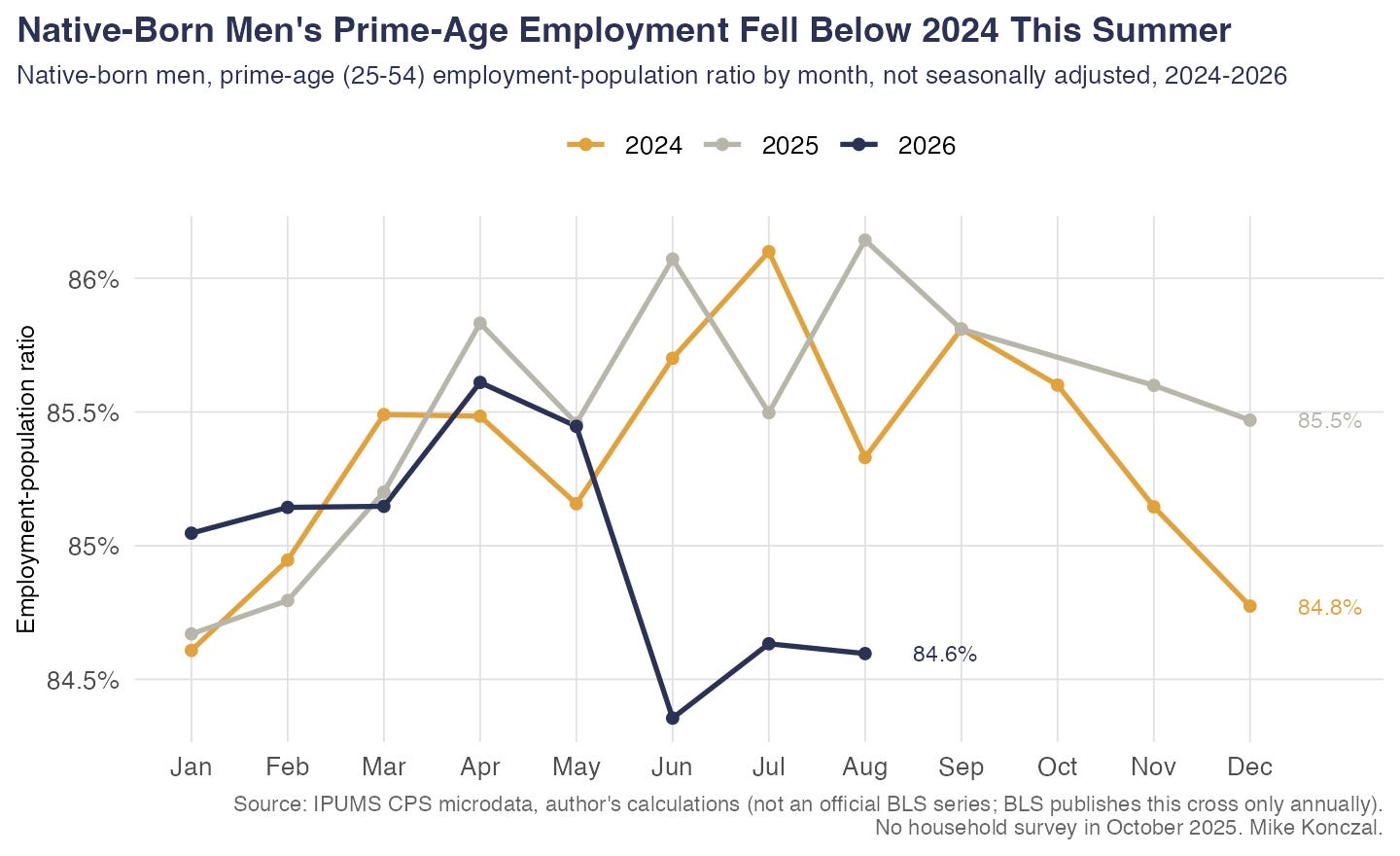
It’s a made-up tale. This employment rate has run roughly around 2024 values, being higher over the last winter but much lower this summer. (Not seasonally adjusted, author’s IPUMS calculation.)
Hypothesis 4: Least-educated native workers would do better. Native-born workers without a college degree should have the most to gain when it comes to unemployment rates.
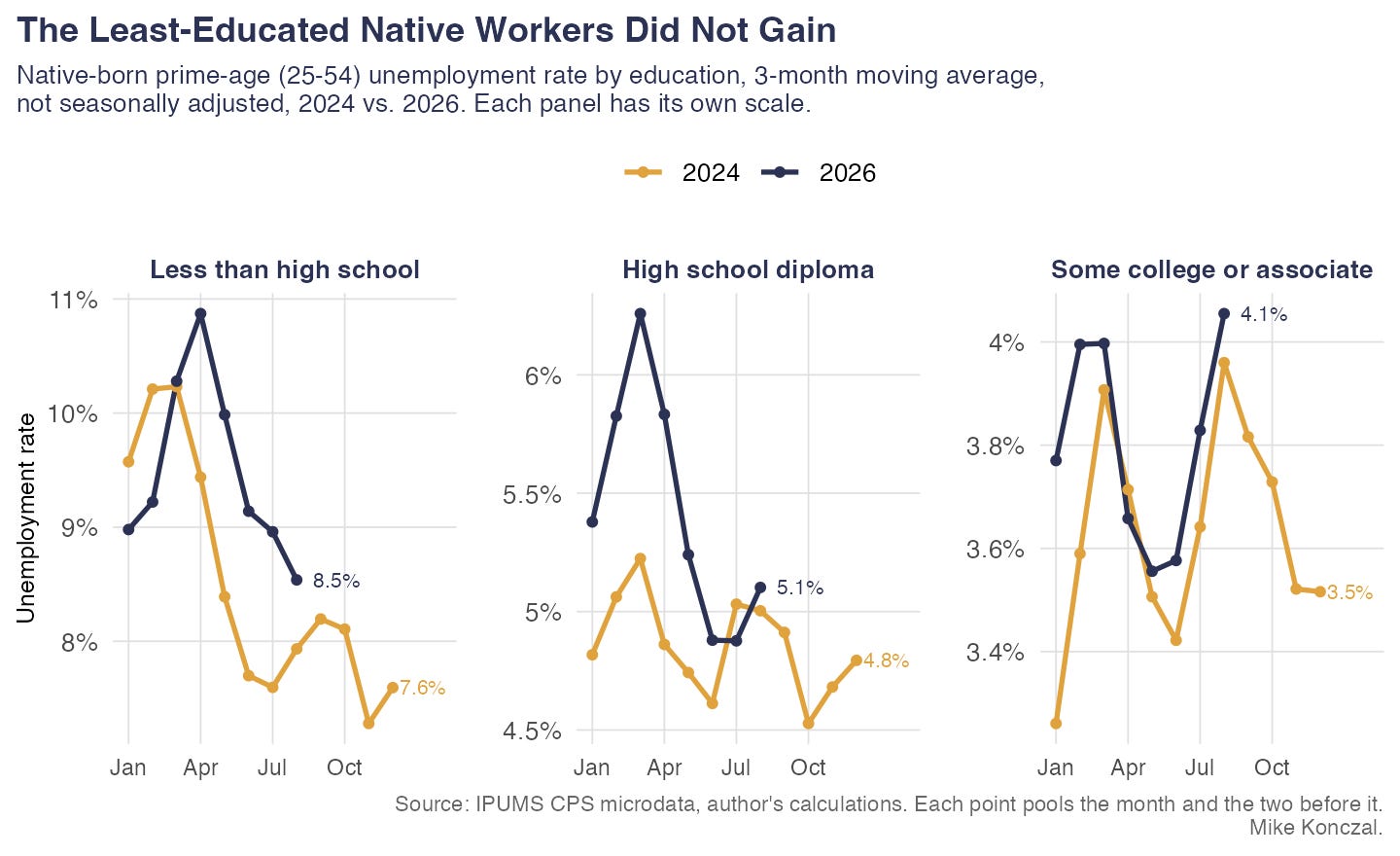
It’s totally pure fiction. (Not seasonally adjusted, author’s IPUMS calculation.)
Hypothesis 5: States with larger declines in noncitizen employment should see larger native-born employment gains.
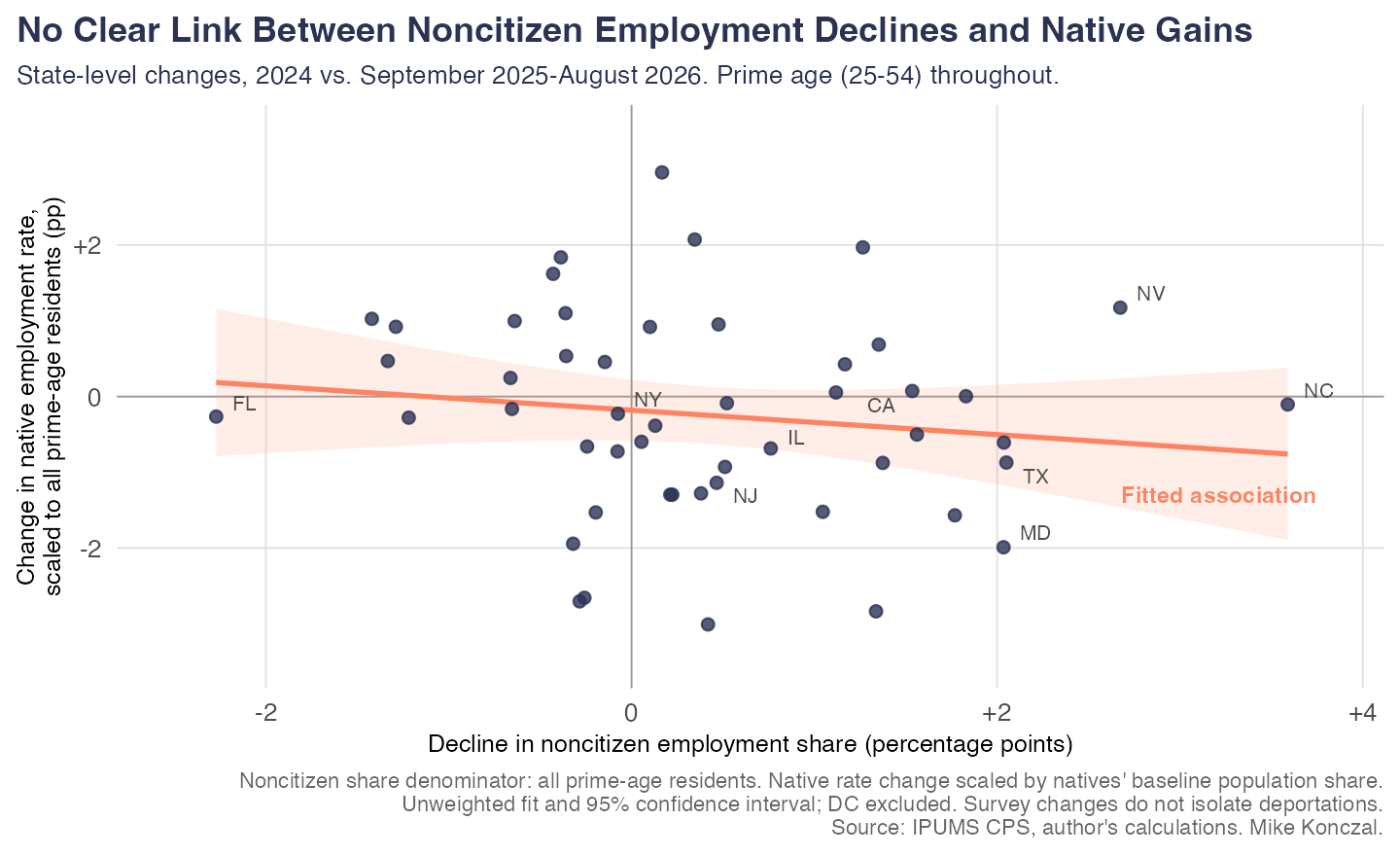
Not a chance. States with larger measured declines in noncitizen employment as a share of their prime-age population don’t see larger increases in native-born employment rates. This shouldn’t surprise us, East et al. (2023) found that Secure Communities reduced employment and hourly wages among U.S.-born workers. (Author’s IPUMS calculation.)
Hypothesis 6: Native-born wage growth would pick up for lower-wage workers. Let’s stick with nominal wage growth for native-born workers, since the Iran war caused inflation to skyrocket (and real wages to fall), which is very bad for these workers but separate from what we want to explore here.
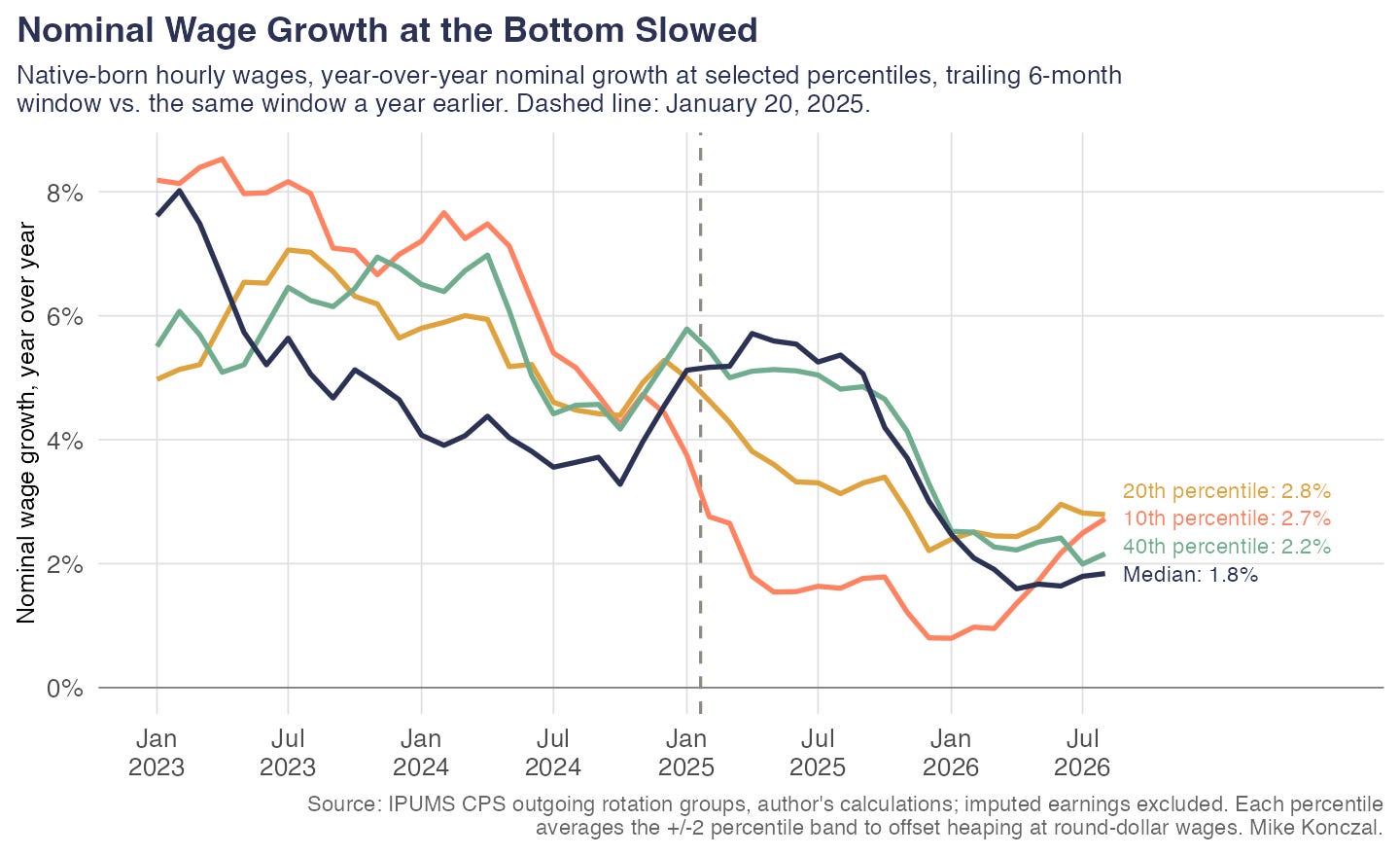
It’s a fake. Whether it is the 10th, 20th, or 40th percentile, wage growth slowed. Some rebound for 10th percentile, but still against an overall collapse; the wage compression was earlier during the reopening. (Not seasonally adjusted, author’s IPUMS calculation.)
Hypothesis 7: Unemployed native workers could at least find work faster because immigrants were out of the way.
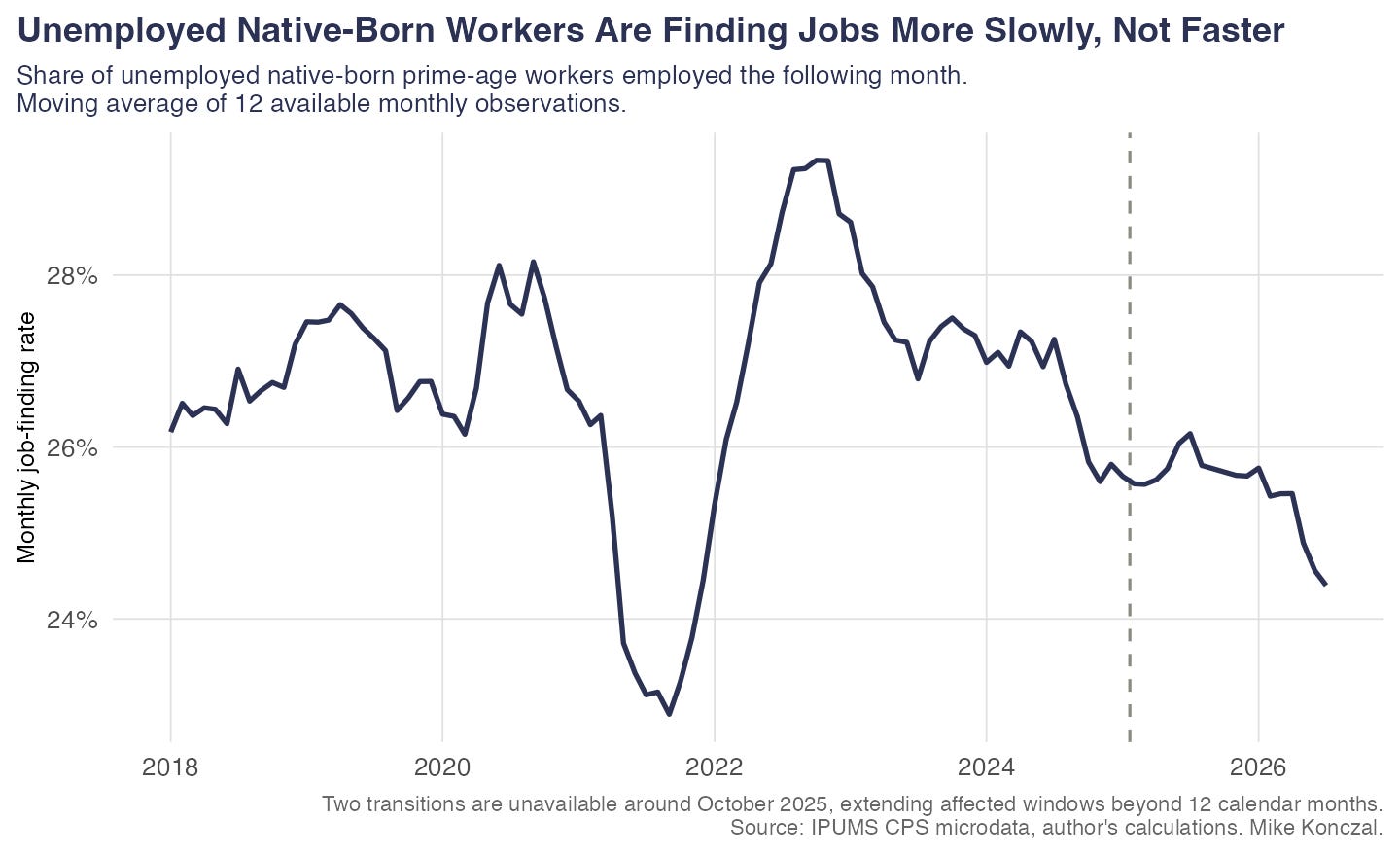
We made it up. The smoothed job-finding rate for unemployed, native-born, prime-age workers slid through 2024, held roughly flat in 2025, and has fallen again in 2026 to its lowest level since 2021.
Hypothesis 8: Immigration is behind the fall in the labor share, so mass deportations should push it back up. That immigration was driving down the labor share was something I remember Batya Ungar-Sargon bringing up during the 2024 election as a reason to support President Trump. I assume other conservatives think this.
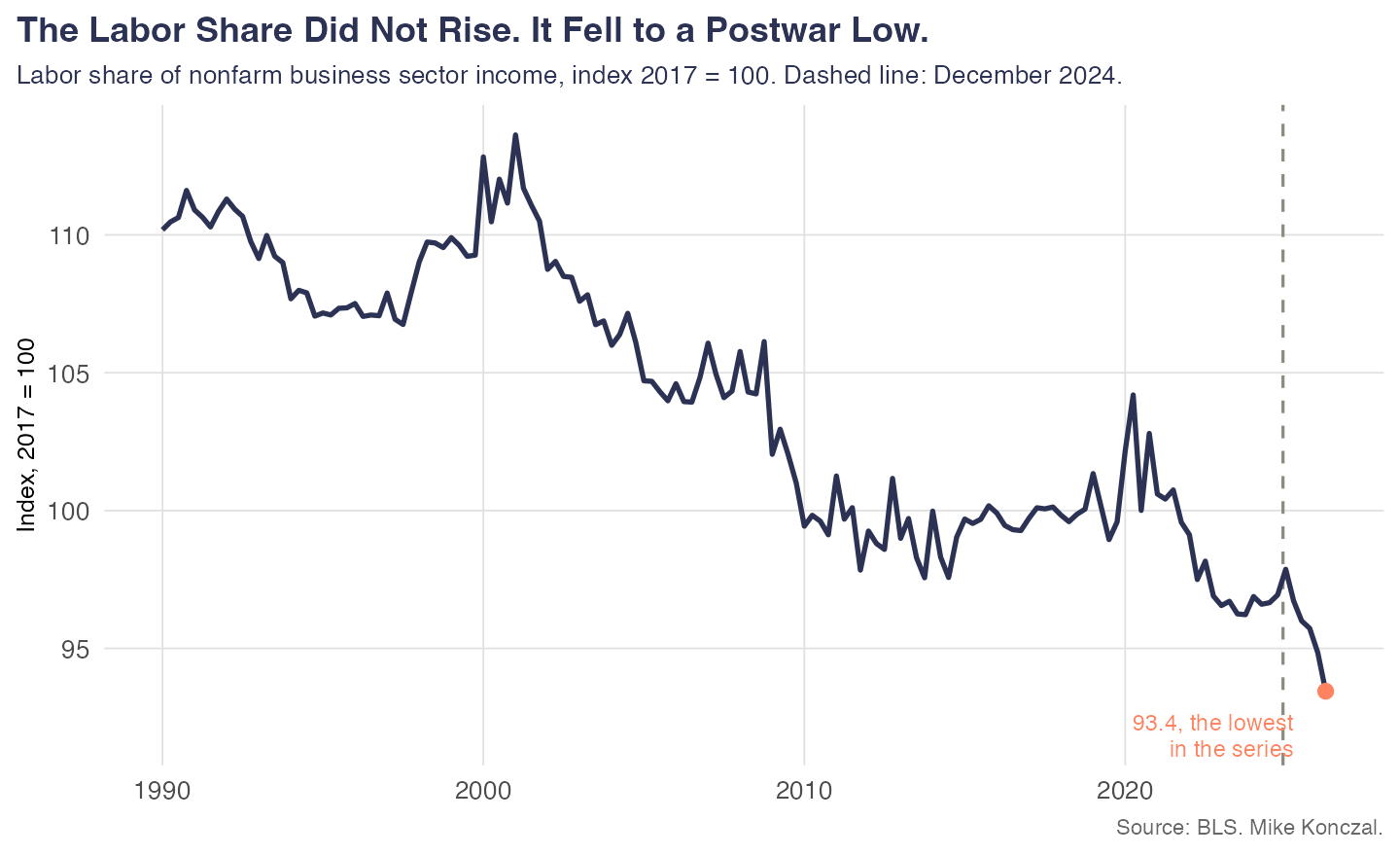
It’s a total fabrication. The labor share actually fell suddenly and dramatically starting at the beginning of Trump’s second term starting in 2025 and continued into 2026, as we discussed in a recent post.
Hypothesis 9: Deportations would tighten the labor market. Job openings per unemployed worker and the quits rate should both rise.
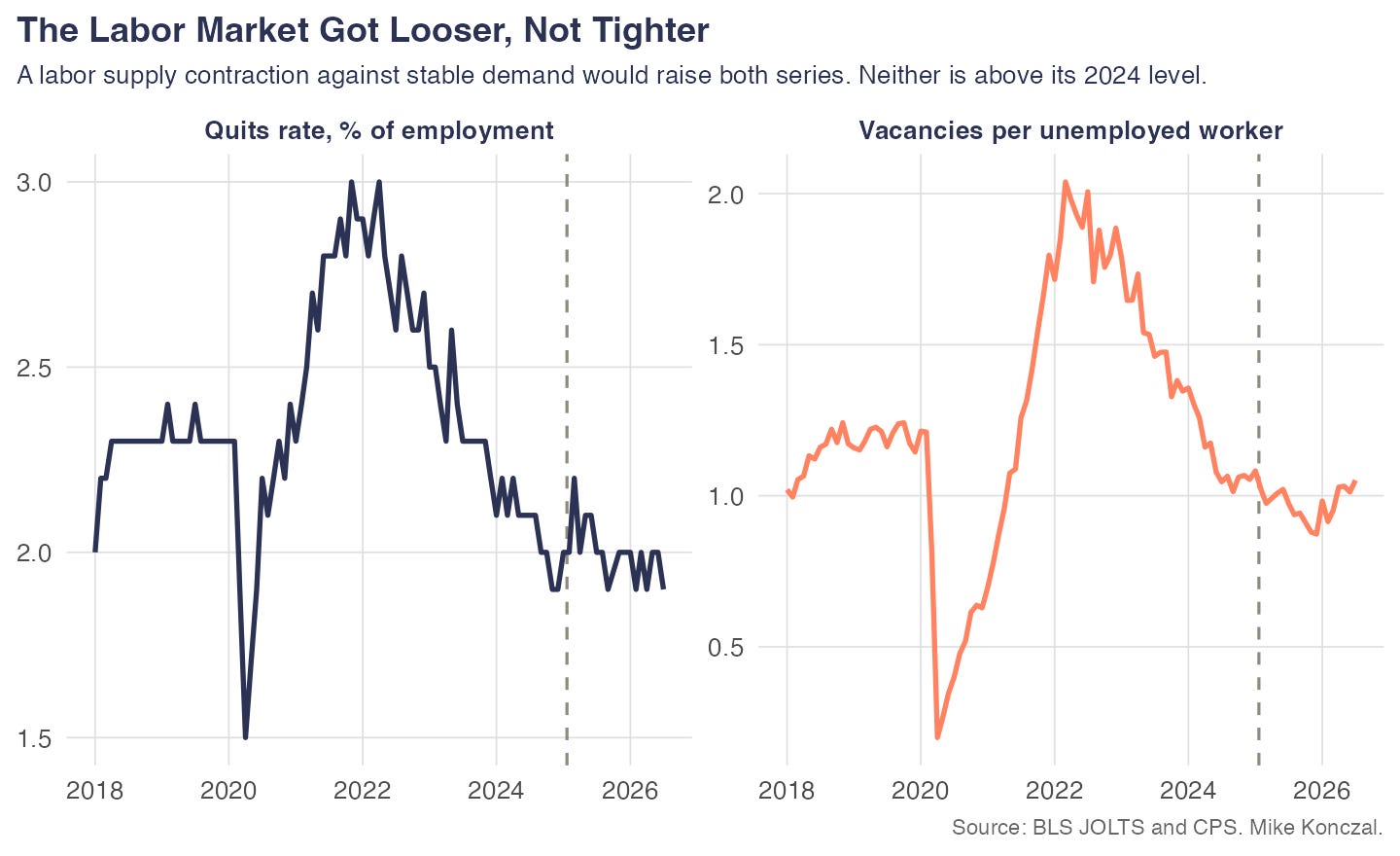
We created it. Both measures are at or below their 2024 levels in 2026. Vacancies per unemployed worker have ticked up this year, but only back to where they were in late 2024.
Hypothesis 10: Native-born workers in construction should particularly benefit. It has a very high foreign-born labor share, and it’s hard to automate with AI.
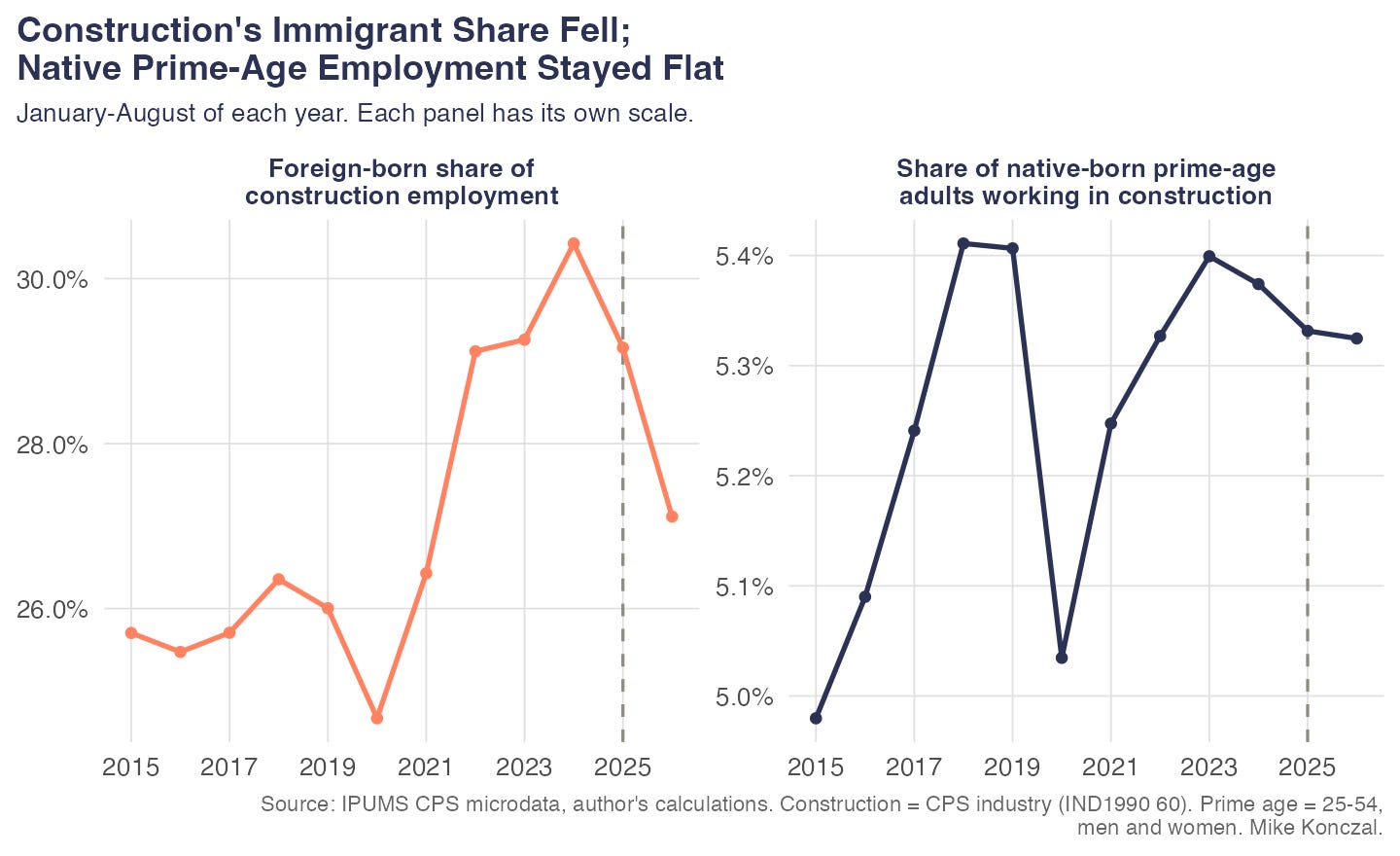
It’s an urban legend. The measured foreign-born share of construction employment fell. But the overall share of native-born prime-age adults working in construction didn’t rise. It stayed roughly flat.
This doesn’t surprise me, and yet I remain surprised by how hard it is to find a broad payoff for native-born workers here. I bet the Trump administration, whose approval now appears to have a 2 handle, is also surprised by how unpopular it and its handling of the economy have become. If they expected these deportations to have such amazing upsides that they’d balance out $1 trillion in health-care cuts and brand new neocon wars, simple economic theory and a well-developed empirical literature would all have told them otherwise.