

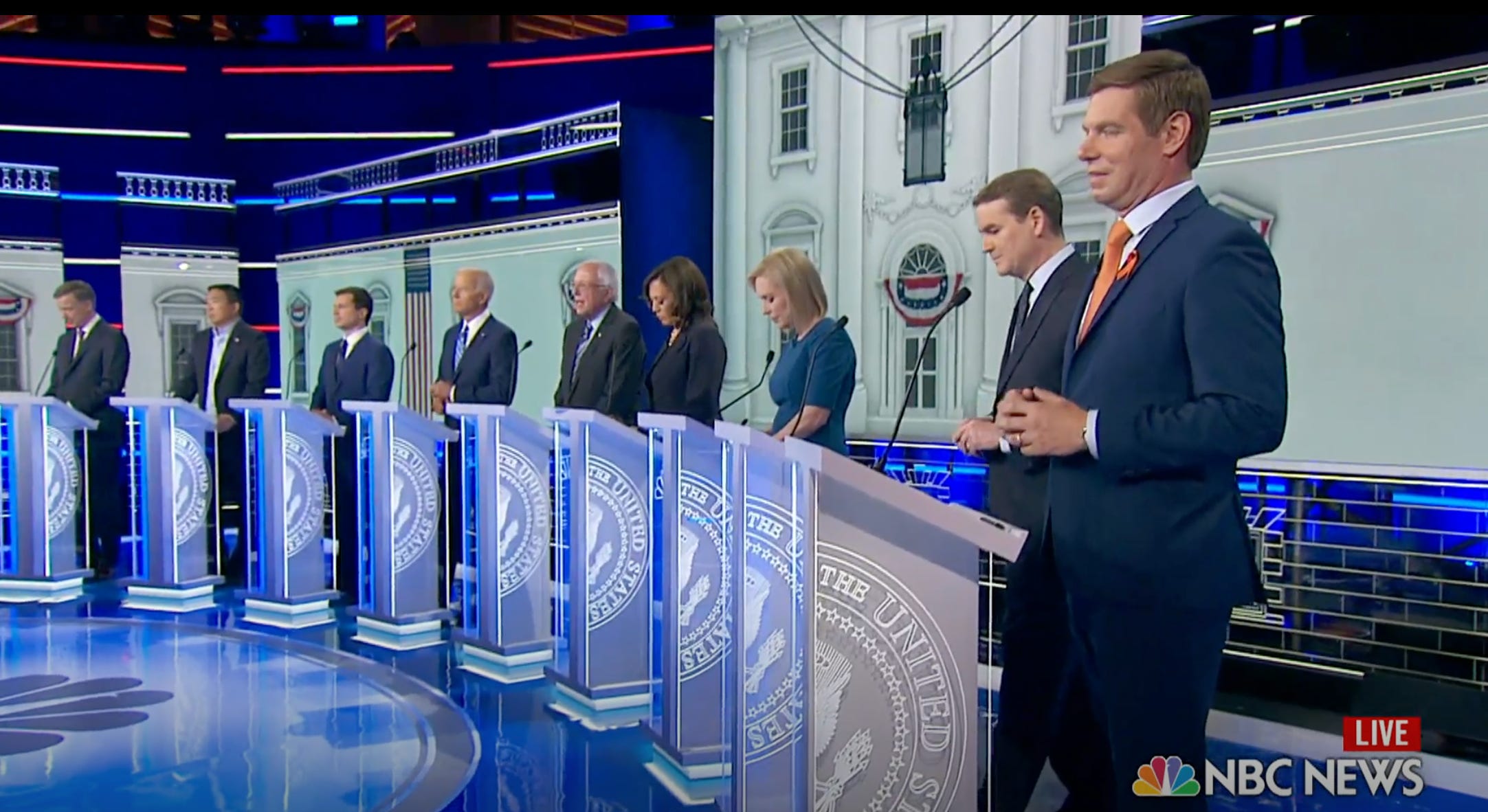
In my little world, people are talking a lot about an “ideas primary” taking place following the midterms and going into the 2028 Democratic primary. This is the world of wonks, activists, and strategists trying to bid up what policies presidential candidates will run on and prioritize going into the next election. After the midterms, and as candidates begin to (likely quickly) announce their campaigns, this conversation will go mainstream.
Many have the 2020 Democratic primary as their mental model. One thing to notice is that both people who celebrate that specific ideas primary and those who detest it treat it as the model for what comes next. Whether you loved that the policy discussed in 2020 pushed the window of possibility further to the left or believe it hung an albatross of too many unpopular commitments on the Democrats, you’re treating it as the template for what comes next.
My gut is that we’ll see something different. My bet is that candidates will have less room to keep adding promises without explaining which come first and how they’ll deliver. The moment here is just so much different that 2020 will prove to be a very poor guide. That’s my read of where things are headed, whatever my preferences. We need to understand the opportunities in front of us. This could be wrong, but hopefully it’s wrong in a productive way, so let’s get it preregistered before it starts. So what’s different? Here are eleven things.
1. The immediate political demands
A. Affordability, not Green New Deal
Going into 2020, the policy framework felt pretty wide open. Trump had upended the political conversation. One of the central demands, a commitment to extensive green energy funding against the backdrop of a Green New Deal, was pitched less as an immediate household issue and instead carried inside it an unproven but at least justifiable theory of the political case, which was that you can marry environmentalism and blue-collar work into an agenda of stopping climate change and building things that could win support in purple and red areas.
Instead of broader theories of coalitions against planetary climate risks, affordability and high prices are what are going to drive the immediate policy framework. I think there’s more to this anger than frustration with sticker shock or the overall price level. Instead people want action on housing, health insurance, energy, transportation, and food. These are problems that aren’t going to go away as people get used to post-pandemic prices. Whether or not you need big and bold changes to address those, they are specific problems with specific solutions whose potential, tradeoffs, and progress voters can judge. An affordability agenda will be judged by whether it can credibly lower the bills people are paying now.
B. Artificial Intelligence
In addition to affordability, artificial intelligence will be the other big domestic issue. In this populist moment, people are wary of AI, and they think it is moving too fast. As the capabilities pick up, as the models proliferate even after whatever bubble is out there, and as more voters see their children, friends’ kids, and grandchildren spend their days being denied entry-level jobs by AI interviewers, it’s easy to imagine public sentiment turning even more negative. And that’s before we see widespread job displacement.
So it’ll be easy to run against AI without much focus on what it should be doing. The broad progressive left could fill that role. But I think it’s fair to say that the left has not coalesced around a positive vision or a set of affirmative demands for the role of AI in society. The contrast with the Green New Deal is notable. Take the April 2019 film “A Message From the Future,” presented by The Intercept and Naomi Klein, narrated by Alexandria Ocasio-Cortez, and illustrated by Molly Crabapple. The film moves from an account of fossil fuel companies blocking climate action to a vision of bullet trains, Medicare for All, and a transformed economy.
It’s hard to imagine the left today making a version of that pitch with AI, where we take on the corporations controlling it, bring the technology under democratic control, and use it to deliver shorter working hours, expanded and better public goods, and the automation of drudgery. Part of that is that the tech is happening through the large corporations nobody trusts; part of it is the left’s own reaction against the tech itself.
Any politician who can figure out and communicate a path forward on AI is miles ahead, and it’s where I’m spending more and more time. But my guess is that it’s largely going to be reactive and defensive, focused on regulatory interventions and taxes. Maybe the taxes are a big revenue source, but I have no confidence about where the surplus will live in the economy.1 But either way it’s a less broad and expansive agenda than what filled the space in 2020.
2. The incentives of the primary have changed
A. Hangover and Overcorrection
People do overcorrect, and there are a lot of people who watched 2020 and believed the candidates overpromised, couldn’t deliver, alienated voters, and didn’t get backing from activists. We have examples. Julián Castro proposing $10 trillion in climate investment and only climbing to eighth of 13 in Greenpeace’s rankings. Kamala Harris and Elizabeth Warren not being able to manage, respectively, whether they’d end private insurance and the actual tax structure of Medicare for All.
These are candidates taking huge hits on something that was nowhere near likely to become law, having nowhere near the Senate support needed for passage. That’s in the background.
B. New Players
In a lot of ways, 2020 was a fight within the Obama coalition and over the Obama agenda. The Biden administration was staffed by many of the same people as the Obama administration, with shifted priorities. Not entirely, but I think we’re going to be more on the other side of that, with new players and new actors. This won’t be the fourth term of the Obama administration, and no new governor running for president is going to be waging a proxy battle over 2016.
I also personally think new players have already synthesized many of those old arguments. Taking on bad actors while expanding supply and addressing broader market failures is not hard, at least at the ideas and electoral level. It’s as easy to get stuck in old debates as it is to overcorrect.
C. No Left Standard Bearer
Bernie Sanders entered the 2020 primary with much of the party believing that there was a credible “Bernie would’ve won” case from 2016. (I believe he would have won.) Other candidates had to decide how to position themselves relative to Sanders’ status as a leading contender.
Who even runs to represent the left flank? With deep respect to people like Representative Ro Khanna and Representative Alexandria Ocasio-Cortez, who do important work, they will not enter with the same tailwind and sense that there’s an obvious case they can win, which Sanders did have in 2020. If AOC doesn’t run, it’s not clear to me you’ll have someone on a strong version of Medicare for All polling at double digits in the primary.
D. Governors
Many of the potential candidates are also governors, who just bring a much more grounded experience managing multiple conflicts and, frankly, keeping their states from collapsing, which is just a different grounding from what more ideologically driven members of Congress bring.
E. Twitter is Over
As they say, Woke 1 was crazy. But the lack of Twitter as a coordination device is noticeable in policy discussions. Traditional media and institutional gatekeepers have collapsed over the past decade for an overdetermined number of reasons. This weirdly made Twitter a main character in how policy debates played out. Though it still carries its weight as a press release platform for political entrepreneurs, the cacophony of Substacks and TikToks will probably drown out any center of gravity.
It’s hard to describe if you weren’t there, but Twitter rewarded candidates who matched the biggest number and punished objections. Twitter still plays a role, but I see less pressure there for candidates to keep outbidding one another on policy commitments. The fragmentation has come even for the platforms that benefited from its first wave.
3. Lessons from Biden and Trump
A. Output and Execution
Many of the people staffing these campaigns (and even some of the people who might run) served in the Biden administration. And there is a thought I’ve observed that hangs over people who served throughout most of it: that they couldn’t prioritize and couldn’t execute. How do you actually interconnect and transmit the green energy you’re making? And what if temporary funding doesn’t build a constituency that can secure a program’s extension (a theory that was always undercooked)?
One can debate these arguments forever; even with better priorities, was there actually a way to get a big piece of social policy through both Senators Sinema and Manchin? What’s the more nuanced theory for why some things succeeded and some things stalled out? No matter your answer, my sense is that the next round of campaigns will put more emphasis on choosing priorities and explaining how they’ll deliver.
A lot of people also take the 2024 loss very personally. The 2016 loss felt easier to explain as a fluke. My bet is that the experience of governing and losing will make promises without a credible account of delivery less valuable than they were in 2020.
B. Failures of Trump 2.0
This is a very populist moment, and populism will rise to the front of what constitutes any ideas primary. But my read of Trump’s second term is that populist appeals won’t carry you far if voters don’t see and feel the improvements you promised.
The Trump administration has delivered on a far-right populist agenda; it just started off so divorced from actual economic grounding that it ended up harming its own voters. Promising that deportations will create jobs doesn’t help if voters don’t see better job opportunities. Defending health care cuts as a crackdown on fraud, immigrants, and people who choose not to work doesn’t answer voters’ concerns about their own insurance bills, which have risen sharply for workers with employer coverage and skyrocketed for people buying ACA marketplace coverage.
Democrats can make the same mistake on the left side. Saying food is unaffordable because corporations are making too much in profits means you’d better have the i’s dotted and the t’s crossed with a credible account of how your policies will lower grocery bills, by roughly how much, and how soon.2 I expect a lot of talk about corporate interests, economic corruption, and the oligarchy during this primary; it’s not clear to me the ways that ultimately connects over the longer term with kitchen table issues for voters.
4. The problems the next president will inherit
A. Loanable Funds World
It’s interesting to live in a loanable funds world. I won’t say live in it again because for most of my adult life I’ve lived in the secular stagnation world and the zero lower bound. But since the response to the pandemic, we’re now much more in a world where it is plausible to me that if we want interest rates to come down alongside high investments, someone needs to be saving more.
Contrast that with the previous 20 years, when it seemed pretty clear, however you want to characterize it, that there was just not enough demand. The problem was getting enough spending and investment into the economy to keep people employed or our resources utilized. We've now moved from a world where there wasn't enough demand to one where supply is the limiting factor.
Moreover, the deficit situation is quite grim in a way I don’t think people appreciate. Restoring Medicaid funding means more federal spending, and ending tariffs means forgoing federal revenue.
B. Social Security
I cannot tell whether this gets negotiated behind closed doors in the Senate or spills out into the Democratic primary. But the trustees project that Social Security’s retirement and survivors trust fund will exhaust its reserves in the fourth quarter of 2032.
I highly doubt, especially in this populist moment where people’s payroll taxes will do real political work, that we’re going to see genuinely large cuts from either party, so the faster they raise the payroll cap, the better it is for the financing. But that can drag on for a long time.
So where does that leave us? I think there’s room for ambitious policy on health care, housing, energy, food, and support for young families. Quite ambitious, in fact. Someone needs to figure out what to say about AI that doesn’t pretend it’s going away. But candidates will need to explain which problems they’ll tackle first and how their plans will produce results.
I will say that as someone thinking actively about this, it’s hard to do AI economic policy, because it’s both too pie-in-the-sky (what do you mean a four-day work week so unemployment is on the intensive and not the extensive margin, you are just accepting the tech industry’s narrative!) and too small scale (better access to more generous UI benefits is just an additional 12 weeks until you are part of the permanent underclass!) all at the same time. This flows from the fact that we can’t really tell how fast it moves through the economy and who the ultimate beneficiaries are.
FWIW I buy the story USDA’s Economic Research Service tells about beef, where the gap between what packers pay for cattle and what they get for wholesale beef took off after 2015. (Notably the fast food industry is angry about it too, with McDonald’s suing the big beef packers over it.) I’ve spent a lot of time in the grocery margin fights, far too much, and while I disagree with, e.g., the New York Fed’s study, I find the plausible monthly household savings to be quite low relative to how upset people are about groceries.
The back-and-forth swings election to election make it hard to deliver anything. We did not get into this mess in 4 years and it will take 20 or more to fix it. We are fortunate to have some levers to pull (excessive healthcare costs, relatively low taxes) to right the fiscal ship (compared to France), but unclear we have the political and societal willpower and patience to act.