

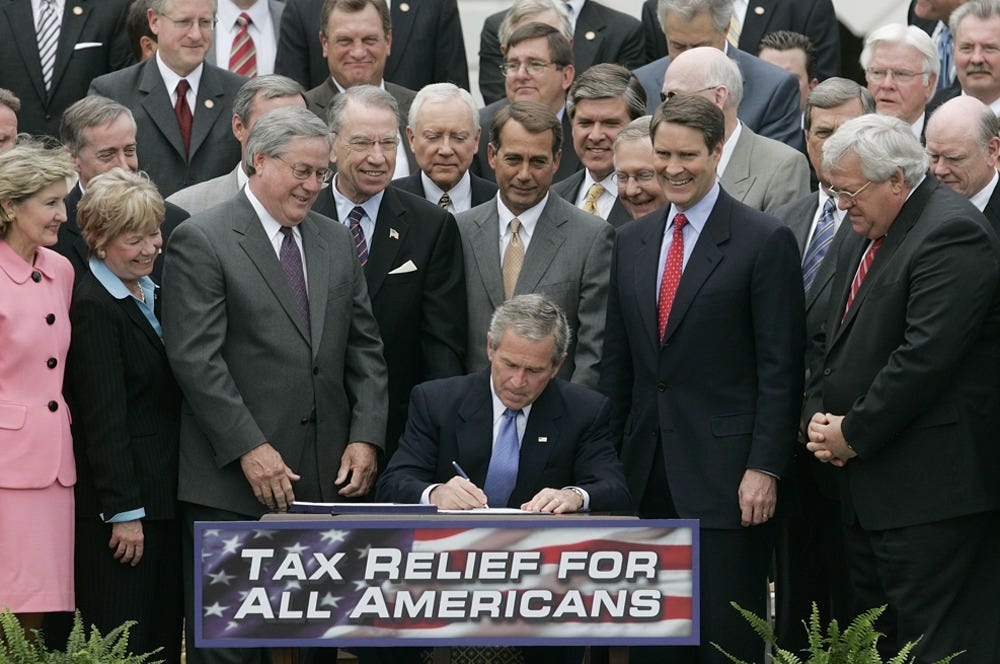
The Van Hollen and Cory Booker tax bills have set off a debate in Democratic politics. Both bills raise taxes on rich people roughly $1.5 trillion. They then, in turn, use those revenues to do a middle-class tax cut. According to the Tax Foundation, Van Hollen targets the $40,000 to $140,000 range for a tax cut; Booker reaches up to $280,000. There’s been significant pushback on the agenda among economic wonks. But another question remains: how did we get here, where some consider middle-class tax cuts an affirmative Democratic agenda?
There’s a clear short-term motivation for the policymakers who’ve put forth these proposals. As Groundwork’s Alex Jacquez helpfully explains in a recent American Prospect piece by David Dayen and Ryan Cooper, this push is largely driven by consultants chasing the perceived political benefit of Trump’s No Tax on Tips. I’m skeptical that those pledges drove Trump’s 2024 win, which has plenty of other sufficient explanations. And even if they did, the right response, in my personal opinion, is to fight on better and more consequential terrain like healthcare.
As for the longer story of how we got here, I don’t have the full answer, but I want to explore it through two moments, one in 2016 and one around 2008. Each is usefully anchored by a contemporaneous editorial that identified the problem as it was happening. In 2016, the Hillary Clinton campaign proposed to fund paid leave not with a payroll tax, not as an extension of Social Security, but with taxes on the wealthy. That decision foreclosed options for building universal social insurance. But it built off the earlier one, around 2008, when then-presidential candidate Barack Obama pledged not to raise taxes for those making below $250,000.
The Bush Trap
By cutting taxes for everyone in the early 2000s with an expiration date, George W. Bush effectively created a ratchet. When the cuts were set to expire at the end of 2010, Obama was boxed in twice over. He had campaigned on a pledge not to raise taxes on families under $250,000, so he could only let the top rates snap back. But the economy was fragile, with unemployment near 9.5 percent, and letting any taxes rise risked pulling demand out of an economy that couldn’t afford it. The result was the December 2010 deal: all the Bush cuts extended, top rates and all, in exchange for unemployment insurance and a payroll tax cut.
When the cuts came up again at the end of 2012, Obama framed the fight around middle-class tax cuts. Then-White House comms director Dan Pfeiffer argued “President Obama today will push for extension of middle class tax cuts. Will the GOP join him to provide certainty for 98% of Americans?”
He ended up striking a different deal, making the Bush rates permanent under $400,000 and raising taxes above that. That decision locked in a tax architecture. The vast majority of the Bush tax cuts were now bipartisan law.
To see criticism of this from when it happened, read Matt Yglesias’s 2009 American Prospect piece, “The Next Tax Revolt.” In it, Yglesias argues that Obama’s pledge didn’t change the anti-tax framework so much as find a way to survive within it, reinforcing the right’s claim that public services aren’t worth paying for. He concludes (italics in original):
Progressive taxation is an important principle. But the idea that further changes to the tax code should exclusively target the wealthy is ultimately counterproductive. Making the case may be difficult, but refusing to try to make it amounts to conceding defeat. At the end of the day, persuading people to support a more active role for government means persuading all of them that such a government is worth paying for.
Those concerns about broader taxation were kept at a distance, in part, because an era of falling interest rates, often called ‘secular stagnation,’ made debt burdens significantly less onerous. The long Great Recession, where the Federal Reserve’s interest rates remained at zero percent for seven years, from the end of 2008 to the end of 2015, made the immediate concern of getting more fiscal spending into the economy central. Meanwhile, growing awareness of inequality pushed policy attention toward the top of the distribution. Ideas like the Buffett Rule, a proposed minimum tax on incomes over $1 million, inspired by Warren Buffett’s observation that he paid a lower rate than his secretary, captured the mood.
Each campaign cycle deepened the tax threshold promise and boxed in policymakers more. Secretary Hillary Clinton championed the Buffett Rule in 2016, and Obama’s pledge was increased to $400,000 by Vice-President Biden while running in 2020. But let’s stick with 2016, and a specific decision flagged by the writer Bryce Covert at the time.
Paid Leave and Payroll Taxes
By 2016 the worst of the recession was behind us (unemployment was just under 5 percent), and there could have been space to discuss broader taxation without wrecking the economy. But the Hillary Clinton campaign kept the pledge and added an important choice: moving paid family leave financing from payroll taxes to taxes on the wealthy.
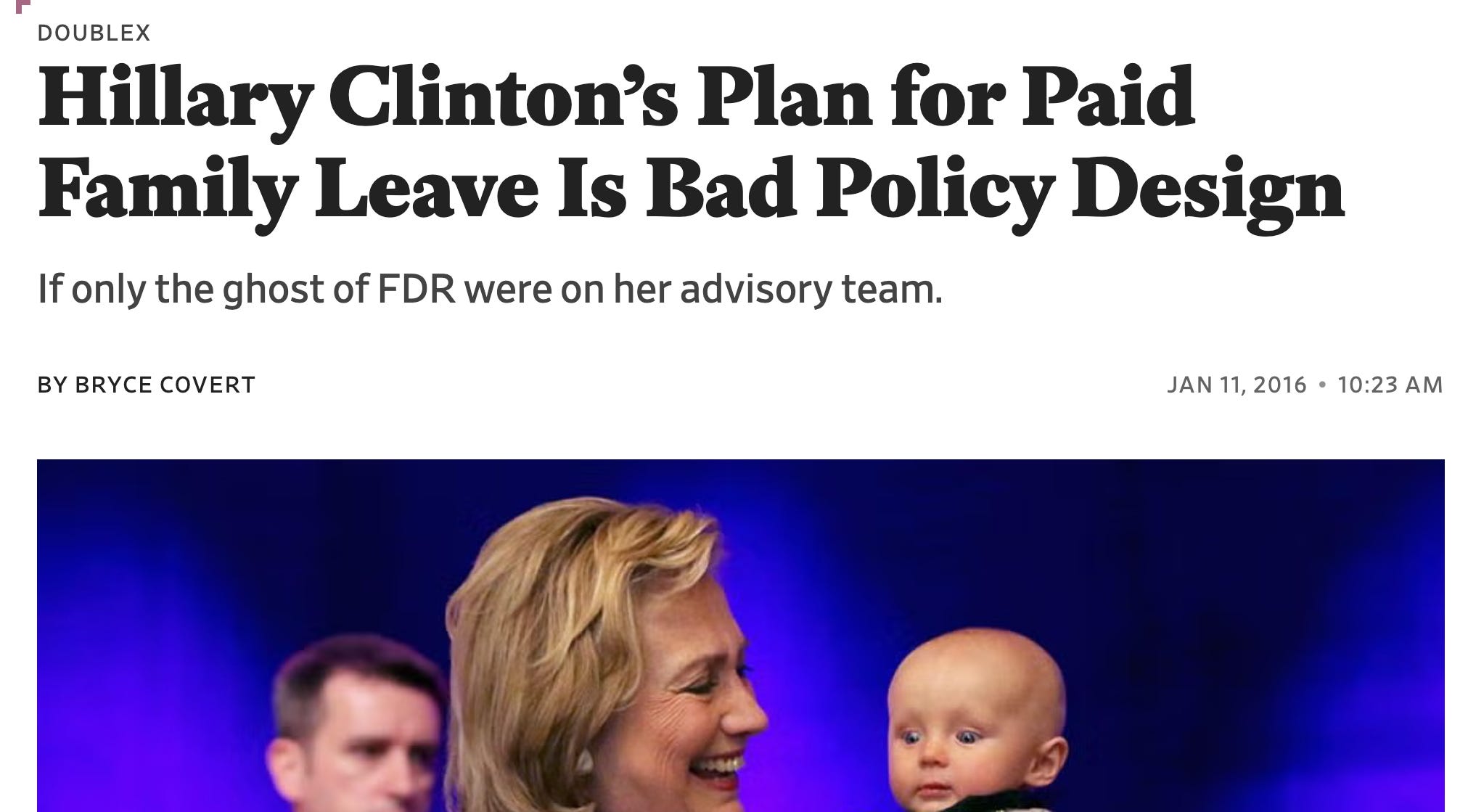
The writer Bryce Covert laid out the case against this in an important 2016 Slate piece, “Hillary Clinton’s Plan for Paid Family Leave Is Bad Policy Design“:
The proposal in Congress would [fund paid leave] by creating a social insurance program akin to Social Security. The bill would levy a new payroll tax—0.2 percent, or about $1.50 a week—on both employees and their employers to fill up the fund, and then the fund would pay out benefits to everyone eligible to receive them when they wanted to take family leave.
Clinton’s problem with this model is that, technically, backing it would bar her from making a promise she’s gotten very keen on making: that she won’t increase taxes, not by one cent, on people who make $250,000 a year or less. “Hillary strongly believes that middle-class families deserve a raise, not a tax increase,” her paid leave proposal states.
The deeper problem, as Covert emphasized, was political durability. Social Security and Medicare have become politically untouchable precisely because people pay in and feel ownership over the benefits.1 Payroll taxes had also been a highly effective model for state paid leave programs, so the Clinton approach meant abandoning a design that was already working.
Social insurance is insurance against lost wages. Payroll taxes are part of the mechanism through which workers contribute to insure themselves against unemployment, disability, sickness, or old age across generations. From the beginning of the study of social insurance, scholars knew that giving birth to children also disrupted earned wages, and thus paid leave belonged in the system.2 It was part of the unequal gendered nature of the New Deal that, as political scientist Suzanne Mettler has argued, the system divided citizens so that men got full benefits and women didn’t. Bringing paid leave into Social Security thus had long-term political benefits.
But none of this was enough to break the no-tax pledge. And during this period, the wonk class had largely stopped making the civic case for payroll taxes. The New Deal understanding that social insurance carries a deeper meaning, that “keep your government hands off my Medicare” reflects something real about how people relate to programs they pay into, that universal contributory programs can be the foundation of democratic solidarity, had faded from the conversation, left largely to heterodox thinkers like Michael Lind. Covert is a friend and I remember discussing this with her at the time. Though I then saw the case for moving the tax burden to the rich, I increasingly think she got this argument right as it occurred.
That is not to say there isn’t a straightforward case for higher taxes on the wealthy funding a broad set of programs and social insurance. You hear from pundits that Americans want Scandinavian social insurance without Scandinavian taxes. I actually don’t buy that’s the right point. The comparison is harder than it looks, and healthcare is the main reason. As both the economists Saez and Zucman in The Triumph of Injustice and Matt Bruenig at People's Policy Project have shown, adding in employers’ U.S. health spending as a tax dramatically increases the regressivity of taxes and largely closes the international gap. That international difference is fundamentally about the way we fund health care.
But as Democrats shape their policy agenda going forward, there is something worth exploring here: whether social insurance can be expanded through two tracks. The rich pay their fair share in our deeply unequal society. But also we affirm a broader commitment that everybody pays in and everybody benefits. That is what was underpinned Social Security in the first place, and it may be what’s needed to get out of the trap we’re in now.
Yet there remain two central ironies. For all the Democratic reluctance to ask anything of the broad middle class, it was Trump who imposed broad-based taxation on working-class individuals through tariffs. He just did it in the worst possible way, for the worst possible reasons, based on lies, and with the revenue going nowhere useful. More, for all that George W. Bush was thrown into the trash heap of history in 2009, here we are in 2026, unable to increase middle-class taxes above the path he set in 2001. And, after the Iraq War we still live with3, we are now waging another full-on war against Iran, another country he named to the Axis of Evil in his 2002 State of the Union. His strategery of playing the long game won, and we all lost.
Now subscribe and watch this drive:
As Covert notes, this was the logic of Franklin Delano Roosevelt, who told an adviser in 1941:
We put those payroll contributions there so as to give the contributors a legal, moral, and political right to collect their pensions and their unemployment benefits. With those taxes in there, no damn politician can ever scrap my social security program. Those taxes aren’t a matter of economics, they’re straight politics.
In his classic Social Insurance (1913), the first textbook on the topic published in the United States, the actuary I.M. Rubinow translated a 1912 German taxonomy of the types of social insurance, with my red text box flagging what we’d now call paid leave among all the important types:
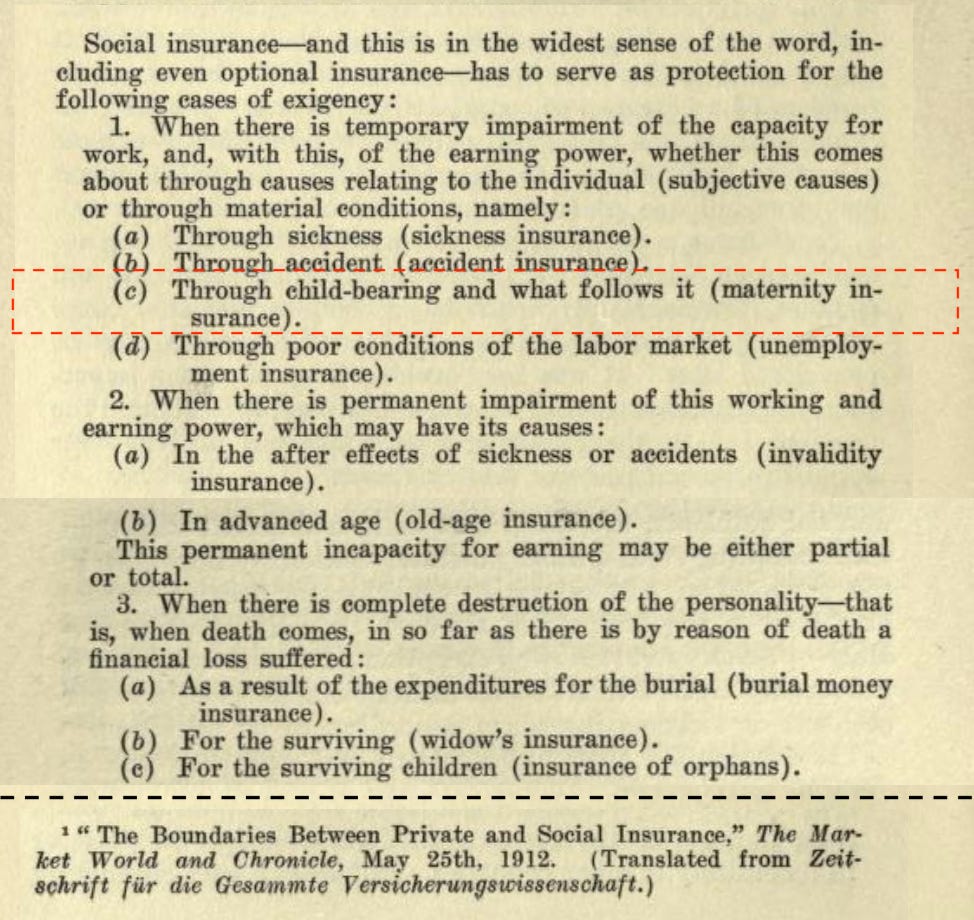
It’s both refreshing to know the central risks of the capitalist modes of production were well articulated in this early 20C book I recommend you check out, and depressing to think the insufficient progress made on addressing them since then.
I am generally hesitant to think we still live in the backdrop of the Iraq War, as writers like Spencer Ackerman and Richard Beck argue, because it fits my politics too well. But then moments like the killing of Renée Good happen, and we learn that the person from ICE who killed her was trained by serving in Iraq. And it’s like, of course, of course citizens protesting the mass round-up of people into concentration camps are being executed by those forged in Iraq, that war based on lies still coming back home to haunt us all.
Won ? Hastert in prison; Bush retired in anonymity, humiliated by the failure of his wars, defeated by his wicked denial of climate change, forever to be known as the second worst President; the names of McConnell and Grassley disgraced; the grifter Frist tricked even by Liz Holmes.
This is so important. People understand insurance and value the peace of mind it brings, but structuring it as insurance also leads to other beneficial policies, because insurance is about managing risk, as well as sharing in the pool of funds that insurance contributions create. You can present policies like vaccinations, or physical fitness programs as ways to manage risk that help to make the program sustainable. Retraining programs, early childhood education investments, college and university all work to make it less likely that people will need to draw on unemployment insurance. It creates all these virtuous circles and because they pay into it they want it to be there for them, and will more readily participate in things that make it sustainable. It is inclusive because you are sharing risks, and yes it promotes solidarity.
Chilling video.