I’m excited today to announce that I’m releasing a new Economic Security Project report, co-written with Ned Resnikoff and my colleague Becky Chao, titled Building Affordability: The Policy Agenda for America’s Housing Crisis. You can read it here (pdf).
It builds on the Affordability Framework Becky and I wrote last fall, where we diagnose affordability and our more general economic challenges as deriving from a combination of broken markets and broken incomes. It struck me as a useful way to break out of the silos of how policy information is created, which tends to focus very narrowly. I also thought the framework was broad enough to cover a lot of ground, but had the depth to make substantive and useful claims. But journalists covering it, such as Rachel Cohen Booth at Vox, flagged that it really needed to be deployed somewhere to see if any of this was true, which I agreed with.
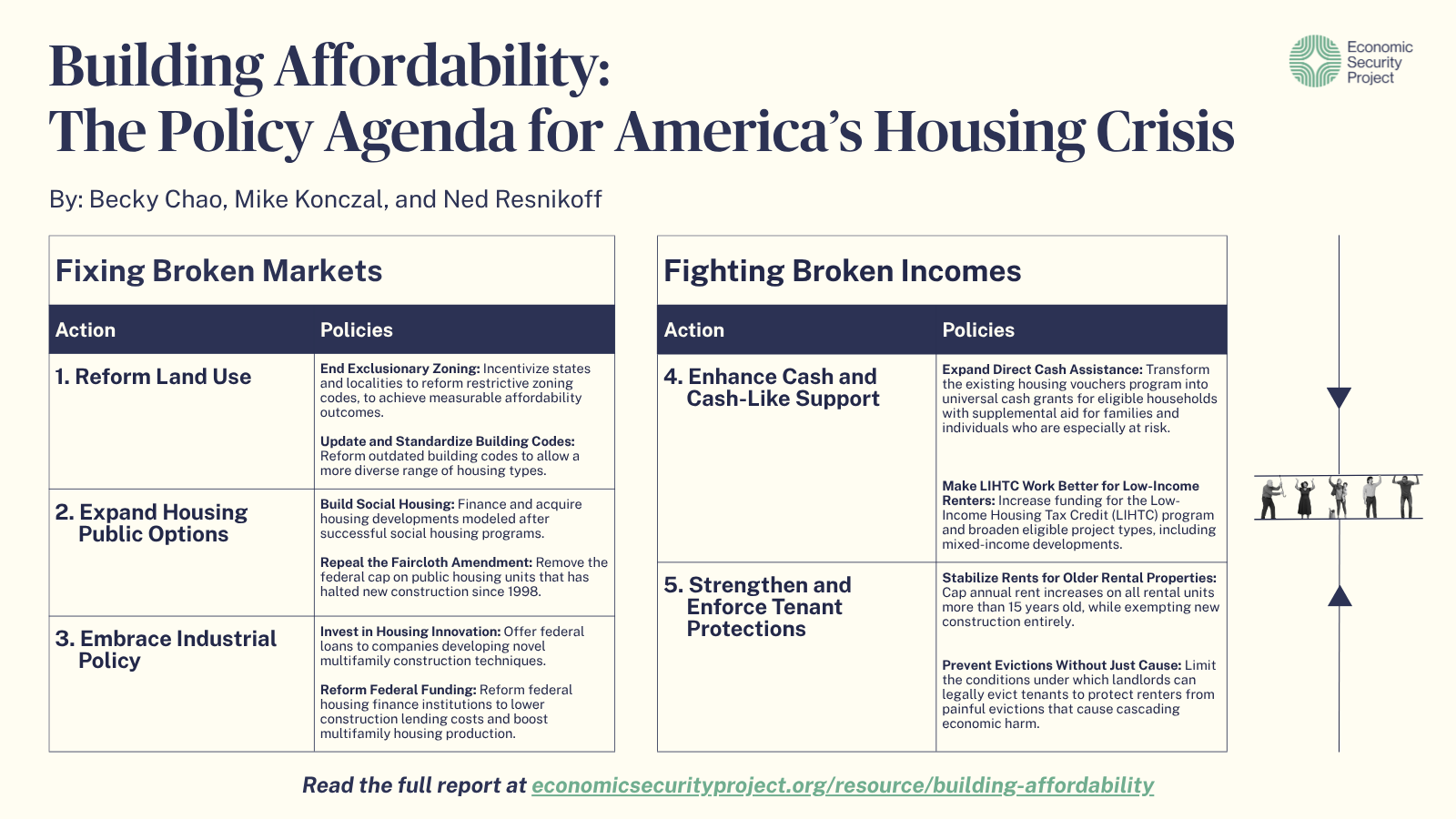
Enter housing. As you can see in the graphic above, we tackle it through missing supply, through broken markets, but also equally emphasize that even when housing markets work, incomes will be a challenge.
There are a lot of housing reports out there, so where does this add value? We think this report pulls from the major camps of thought around housing. But I think a useful way to approach it is to contrast it against the Abundance movement right now.
This paper takes the YIMBY arguments very seriously and I think it continues to push them, for instance by bringing building codes more centrally into the conversation. But there are two challenges it poses.
The first is that because supply matters so much, we should go further than zoning. We focus on public options in housing, which become easier to stand up if we do the YIMBY playbook and address construction costs and building codes. But we should also reexamine financing as well as industrial policy for innovation too. Reflecting on their book Abundance one year out, the writers Ezra Klein and Derek Thompson flagged financing as the big question mark once you get past zoning. That’s why I think there have been a number of proposals out there, such as Chris Hughes and Aaron Klein at Brookings, from the Center for Public Enterprise, and from Groundwork Collaborative, taking this seriously. We give an overview.
The other challenge is taking the income side seriously as well. As my co-author Ned Resnikoff puts it, increasing supply can do quite a lot: research suggests that in a healthy housing market, one where there’s enough market-rate housing to meet demand, people making as low as 60 percent of an area’s median income can likely find a decent place to live. But even under those circumstances, you still have people at 50 percent of area median income, or 30, or 20, or zero. That population is going to need some form of support no matter how much market-rate housing we build.
If you want to get your hands around urban inequality, and deep housing cost burdens and homelessness in particular, you need to do more than build housing. You also need to stabilize the incomes of the people the market alone can’t reach and, with thoughtfully designed tenant protections, insulate them against sudden shocks. These two focuses are not in conflict.
It seems like the politics of housing is ripe for this kind of convergence. Check out what New York City Mayor Mamdani said in late May as he launched his housing plan:
The conversation around housing was framed as a simple binary, a question reduced only to yes or no, a side you had to take between structures and people: “Do you believe in building, or do you believe [in] fighting for tenants? Should we build our way out of this, or should we organize to preserve what we have?”
For a long time, the two were framed as mutually exclusive. [...] As we made it easier for New Yorkers to stay in their homes, one thing became increasingly clear. There was no way to drive down housing costs without also building more housing. [...] And data from other American cities told a clear story of what that building could lead to. Between 2015 and 2024, 120,000 homes were built in Austin. In December of 2021, Austin's median rent was $1,546. By this past January, it had fallen to $1,296, even as the city's population continued to grow. I saw these same patterns in Minneapolis and Seattle. It was clear when it comes to housing, the binary we face is not between structures and people. It is not between building and organizing, nor is it between the tenants of today and the tenants of tomorrow.
It is a far more basic one. It is between a government that debates and a government that delivers. We can keep people in their homes, and we can build the homes that they need to live in.
I hope you check it out! We have a Zoom seminar this afternoon at 3pm ET if you are interested in watching us discuss this.