

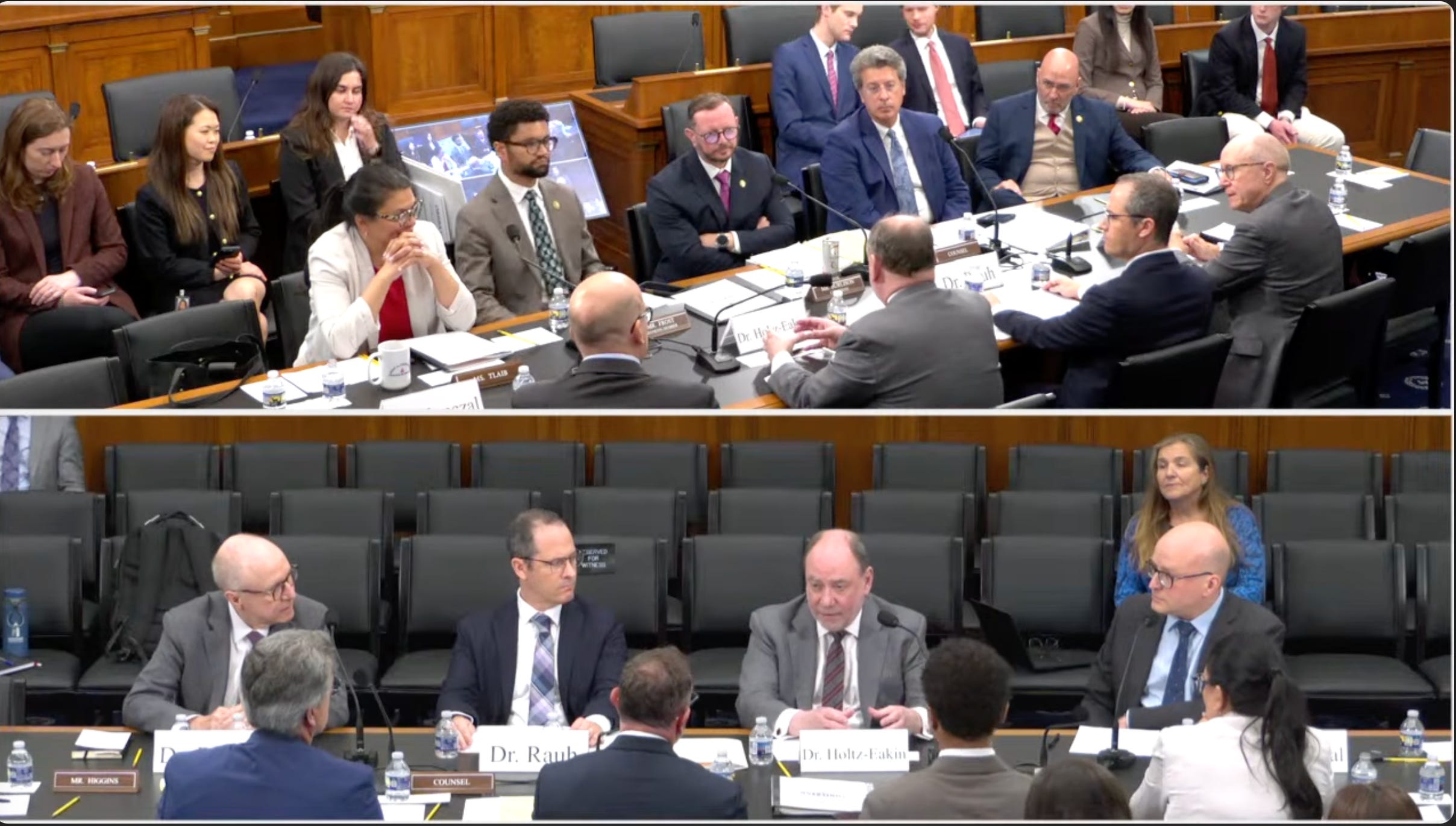
Two weeks ago I gave testimony to the House Committee on Oversight and Government Reform, Subcommittee on Economic Growth, Energy Policy, and Regulatory Affairs. It was for a ‘roundtable’ titled Reducing America’s National Debt: Rooting Out Federal Waste, Fraud, and Overregulation.
It wasn’t clear in advance if the focus was the debt, waste, or regulation, so my opening remarks (presented below) quickly touch on each. I took the opportunity to be critical of the Trump administration’s second term.
But to give you a sense of how President Trump is warping the Republican Party and making Congressional Republicans vestigial, it wasn’t actually a hearing. The testimony from me and the three Republican witnesses wasn't even entered into the record. This is because hearings give members the ability to request subpoenas and otherwise act by majority vote.
Some Democrats had been teaming up with Republicans to use Oversight subpoena powers to actually govern; this is how the Epstein files got subpoenaed. But rather than having hearings potentially result in bipartisan votes for accountability that might impact Trump, Republican leadership is just replacing hearings with fake ones called roundtables. (You can read more about this from Arthur Delaney here as well as The Hill here.)
The roundtable is on YouTube here. It was so small we could all sit across from one another. The closeness made it less likely I’d get hit with personal attacks or gotcha questions that have become an occupational hazard of testifying these days.
I will say, having done (actual) hearings during peak inflation in 2022, when everyone hated the economy, it was much more fun to point out people hate the economy even more out here in 2026. Of course consumer sentiment is lower than in 2024; inflation is higher, the health care cuts are brutal, and the President is on a war tour rather than dealing with anything people face. It was a blast to point this out multiple times!
My statement is below. You will notice it draws from many peer think tank groups; this gives you a sense on where the current thinking is on many of these topics.
Chairman Burlison, Ranking Member Frost, and members of the Subcommittee, thank you for the opportunity to testify. My name is Mike Konczal. I am Senior Director of Policy and Research at the Economic Security Project, where we advocate for ideas that build economic power for all Americans. Before that, I was Special Assistant for Economic Policy to the President at the National Economic Council during the Biden administration.
Debt
If you are concerned about the trajectory of the debt and deficit in this country, the One Big Beautiful Bill Act (OBBBA) was a generational mistake. It is impossible to reconcile being worried about the national debt with supporting the actions taken with that law.
At a moment of near full employment with elevated interest rates, there was an opportunity to think seriously about reconciling the medium-term trajectory of revenues and spending. The Trump administration did the exact opposite. CBO scored OBBBA as adding $3.4 trillion to deficits over the next decade (Congressional Budget Office, 2025a).
To partially pay for the tax cuts driving that deficit, the bill imposed severe cuts to healthcare, food, and income support, layered on top of tariffs that American consumers are now bearing in higher prices. You can’t take the debt seriously by having Americans sacrifice so the already wealthy can pay even less.
The CBO finds that under OBBBA itself, the bottom 20 percent of American households are worse off as a result of this law, losing a total $24 billion each year while the top 10 percent gain $190 billion. Once you also account for the administration’s tariffs, the Yale Budget Lab estimates that households in the bottom 70 percent on average lose ground. The bottom decile loses more than $2,000 a year, over 5 percent of their income, while the top decile alone gains nearly $10,000 (see Figure 1) (Congressional Budget Office, 2025b; The Budget Lab at Yale, 2025). This constitutes a major shift to the wealthy from everyone else, and these outcomes represent a striking failure of economic policy: they manage to shrink paychecks for the majority while simultaneously exploding the deficit.
Figure 1. OBBBA plus Trump tariffs drain income for the bottom 70 percent of households, while the top 10 percent net a sizable gain. Combined average annual change in household resources by income decile, dollars per household. Source: The Budget Lab at Yale, Combined Distributional Effects of the OBBBA and of Tariffs, December 2025 update (tariff policy as of November 17, 2025).
The reason we are on this trajectory is because of the repeated tax cuts that hollowed out our ability to raise reasonable revenues consistent with the promises we’ve made: for the social insurance that gives families income security, for dignified retirement, for the public investment that keeps us a world leader. Twenty-five years ago, there was no structural budget deficit, as revenues were expected to keep up with the rising costs associated with the retirement of the Baby Boom generations.
In 2012, before most of the Bush tax cuts were made permanent and before the 2017 Trump tax cuts were even on the table, CBO projected the 2025 deficit at 1.8 percent of GDP. In reality, it came in at 5.8 percent. The entire gap is a revenue story. Programmatic spending in 2025 came in slightly below what CBO had projected back in 2012. Revenue came in more than four percentage points of GDP below it (see Figure 2). Estimates from the Center on Budget and Policy Priorities find that without the Bush and Trump tax cuts, debt-to-GDP ratios would be around 55 percent, not the 100 percent it currently is (Duke, 2026; Bernstein & Kogan, 2026). Today’s deficits come from 25 years of tax cuts eroding the revenue base, not from new programs or runaway spending. The obligations Congress already made are arriving on schedule.
Figure 2. Permanent tax cuts lifted 2025 deficits well above 2012 projections. Actual 2025 vs. 2012 CBO projection — before Trump tax cuts, with permanent Bush cuts — as a share of GDP. Chart replicated from the Center on Budget and Policy Priorities; CBPP analysis of 2012 CBO projections and CBO Economic and Budget Update, February 11, 2026.
Waste
This committee is tasked with tackling government waste. The OBBBA is designed to create a giant, wasteful time tax on families who rely on Medicaid and other programs. Forcing eligible people to continuously refile paperwork, document their hours, and re-verify their income is every bit as wasteful and ineffective as the federal projects this committee has long criticized. It just shifts the waste onto working families. CBO’s own analysis finds that more than 10 million Americans will lose health coverage under this law (Georgetown Center for Children and Families, 2025). CBO has also found that under state-level work requirements, many participants lose coverage because they were unaware of how these bureaucratic processes work or found it too difficult to demonstrate compliance (KFF, 2025). Most of the people pushed off these programs are not ineligible. They are simply unable to bear the time-tax of paperwork, especially those taking care of children, seeking higher-paying employment, or working multiple jobs to make ends meet.
Worse, research from The Hamilton Project finds that the majority of SNAP and Medicaid recipients subject to work requirements are already in the labor force, but more than a third will periodically fall below a required hours threshold. This means they will lose coverage not because they stopped working, but because their hours dipped below a requirement in a given month. This is not by their own choice. Low-wage workers will lose coverage simply because of the volatile, unpredictable scheduling common in their industries, like service-sector work. Workers shouldn’t lose health care because their employers cut their hours (Ananat et al., 2025; Bauer et al., 2018).
If we are serious about waste, fraud, and abuse, we already know where it is. We know that the tax gap, taxes legally owed but not paid, runs at roughly $700 billion every year, with the top 1 percent of earners alone accounting for more than $160 billion (Internal Revenue Service, n.d.; Sarin, 2021). We know that every $1 invested in IRS enforcement against high-income taxpayers returns at least $5 in revenue, with returns running even higher at the top of the income distribution (Internal Revenue Service, 2024). Rather than address these clear sources of unfair waste, this administration has gone in the opposite direction, gutting the enforcement capacity the Inflation Reduction Act built up (Rubin, 2026; Bryant et al., 2026). We know that Medicare Advantage plans are overpaid by an estimated $80 to $140 billion every year through upcoding and favorable selection. The Committee for a Responsible Federal Budget projects $1.3 trillion in overpayments over the coming decade (Committee for a Responsible Federal Budget, 2026).
Regulations
Now when it comes to regulation, we are living through the worst regulatory environment for business on record under this administration. Companies dislike bad regulations, but they hate regulatory uncertainty. The Economic Policy Uncertainty Index hit its highest readings on record in 2025, with the average value during this term matched only by the months immediately following the COVID outbreak (see Figure 3) (Baker et al., 2016).
Figure 3. Average policy uncertainty under Trump rivals only the COVID shock. Legacy Three-Component Economic Policy Uncertainty Index, monthly, 2000–2026. Source: Baker, Bloom, and Davis, policyuncertainty.com. Dotted red line = average of monthly values across 2025–2026.
This administration has personalized regulation on behalf of its own interests, using federal power as leverage against specific companies and the people who run them. The President pressured Intel into giving the federal government a 10 percent equity stake, bragging publicly that the company’s CEO “walked in wanting to keep his job, and he ended up giving us $10 billion for the United States” (NPR, 2025). The FCC approved Paramount’s $8.4 billion merger with Skydance only after the company paid the President $16 million to settle a personal lawsuit, with the President then publicly claiming an additional $20 million in advertising commitments from the new owners (Newsweek, 2025; Variety, 2025). The Defense Department designated the American AI company Anthropic as a national security supply-chain risk, which is normally reserved for firms tied to foreign adversaries like China and Russia, over disagreements about what its models could do for the government (Fortune, 2026). The Department of Energy abruptly canceled $7.6 billion in already-awarded funding for 223 clean energy projects in October 2025, with all but a handful located in states that voted against the President, signaling to any developer that federal commitments can be revoked based on the politics of the zip code (Washington Post, 2025; PBS NewsHour, 2025).
No CEO making a capital expenditure decision today can be confident that next year’s deal won’t be the subject of tomorrow’s investigation.
Conclusion
Finally, if we are serious about affordability and the national debt, we cannot stand by while the President exerts personal political pressure on members of the Federal Reserve, including criminal investigations against a sitting governor and the [then current] Fed Chair, alongside sustained public campaigns demanding the rate cuts the President wants. This is a fiscal concern as much as a democratic one. Political pressure on the Fed creates a political instability premium. That premium raises rates on the national debt and on the credit cards, mortgages, auto loans, and small-business loans Americans use every day (The Budget Lab at Yale, 2024).
It does not surprise me that Americans are far angrier about this economy than they were in 2024. Consumer sentiment and economic approval polling have both deteriorated sharply this year, especially as inflation has accelerated. Americans see large-scale cuts to programs they rely on, and new limits on proven economic boosts for families that we should instead be expanding, like the monthly Child Tax Credit. They see an administration that is not prioritizing their kitchen-table issues or the long-term health of the government’s finances. There is still time to put the fiscal trajectory on a sustainable footing. But every month we delay, and every disastrous funding cut and revenue loss of OBBBA that gets locked in further, makes the work harder.
Thank you. I look forward to the discussion.
References
Ananat, E., Gassman-Pines, A., & Howard, O. (2025, May). Work requirements penalize workers in volatile occupations. The Hamilton Project. https://www.hamiltonproject.org/publication/post/work-requirements-penalize-workers-in-volatile-occupations/
Baker, S. R., Bloom, N., & Davis, S. J. (2016). Measuring economic policy uncertainty. Quarterly Journal of Economics, 131(4), 1593–1636.
https://www.policyuncertainty.com
Bauer, L., Schanzenbach, D. W., & Shambaugh, J. (2018, October). Work requirements and safety net programs. The Hamilton Project. https://www.hamiltonproject.org/publication/paper/work-requirements-and-safety-net-programs/
Bernstein, J., & Kogan, B. (2026, February). President Trump’s “Big Beautiful Bill” raises the fiscal gap to 2.4 percent. Center for American Progress. https://www.americanprogress.org/article/president-trumps-big-beautiful-bill-raises-the-fiscal-gap-to-2-4-percent/
Bryant, K., DeBot, B., & Leiserson, G. (2026, February 24). The bipartisan budget deal rewards tax cheats and sets up the IRS to fail. Tax Law Center at NYU Law. https://taxlawcenter.org/blog/the-bipartisan-budget-deal-rewards-tax-cheats-and-sets-up-the-irs-to-fail
Committee for a Responsible Federal Budget. (2026, March). New data suggests MA overpayments of $1.3 trillion over the next decade. https://www.crfb.org/blogs/new-data-suggests-ma-overpayments-13-trillion-over-next-decade
Congressional Budget Office. (2025a, July). Estimated budgetary effects of Public Law 119-21. https://www.cbo.gov/publication/61570
Congressional Budget Office. (2025b, August). How the 2025 reconciliation act (Public Law 119-21) will affect the distribution of resources available to households. https://www.cbo.gov/interactive/2025-reconciliation-act
Duke, B. (2026, March). Costly tax cuts increase our nation’s fiscal challenges. Center on Budget and Policy Priorities. https://www.cbpp.org/research/federal-tax/costly-tax-cuts-increase-our-nations-fiscal-challenges
Fortune. (2026, February 27). Trump orders U.S. government to stop using Anthropic but gives Pentagon six months to phase it out while Hegseth adds supply-chain risk designation. https://fortune.com/2026/02/27/trump-us-government-anthropic-claude-pentagon-6-months-phaseout-ai-standoff/
Georgetown Center for Children and Families. (2025, August 14). New CBO health coverage estimates of budget reconciliation law. https://ccf.georgetown.edu/2025/08/14/new-cbo-health-coverage-estimates-of-budget-reconciliation-law/
Internal Revenue Service. (n.d.). Tax gap projections for tax year 2022 (Publication 5869). https://www.irs.gov/pub/irs-pdf/p5869.pdf
Internal Revenue Service. (2024, February). Return on investment: Re-examining revenue estimates for IRS funding (Publication 5901). https://www.irs.gov/pub/irs-pdf/p5901.pdf
KFF. (2025, July). A closer look at the work requirement provisions in the 2025 federal budget reconciliation law. https://www.kff.org/medicaid/a-closer-look-at-the-work-requirement-provisions-in-the-2025-federal-budget-reconciliation-law/
Newsweek. (2025, July 24). CBS, Nickelodeon, Paramount Pictures head to Skydance after Trump lawsuit settlement. https://www.newsweek.com/paramount-merger-skydance-approved-fcc-trump-settlement-2103793
NPR. (2025, August 22). Intel will give the U.S. government a 10% stake, Trump says. https://www.npr.org/2025/08/22/nx-s1-5509673/trump-says-us-government-will-take-stake-intel
PBS NewsHour. (2025, October 2). White House cancels nearly $8B in clean energy projects in blue states. Associated Press. https://www.pbs.org/newshour/politics/white-house-cancels-nearly-8b-in-clean-energy-projects-in-blue-states
Rubin, R. (2026, April 12). America’s new tax mantra: “The IRS isn’t going to catch me.” Wall Street Journal. https://www.wsj.com/politics/policy/irs-staffing-tax-enforcement-1a18e33f
Sarin, N. (2021, September). The case for a robust attack on the tax gap. U.S. Department of the Treasury. https://home.treasury.gov/news/featured-stories/the-case-for-a-robust-attack-on-the-tax-gap
The Budget Lab at Yale. (2024, May). Political risks to the U.S. safe harbor premium. https://budgetlab.yale.edu/news/240502/political-risks-us-safe-harbor-premium
The Budget Lab at Yale. (2025, August). Combined distributional effects of the One Big Beautiful Bill Act and of tariffs (December 2025 update). https://budgetlab.yale.edu/research/combined-distributional-effects-one-big-beautiful-bill-act-and-tariffs-0
Variety. (2025, July 31). Trump claims Skydance to give $20 million in ads with Paramount merger. https://variety.com/2025/tv/news/trump-unconfirmed-claim-skydance-20-million-advertising-psas-paramount-deal-1236467234/
Washington Post. (2025, October 2). Trump officials cancel $7.6 billion in clean energy projects. https://www.washingtonpost.com/climate-environment/2025/10/02/clean-energy-grants-canceled/
Thanks for telling the Orange Man and his ilk what really ails our economy.
Love it. Great opening statement. Why do I envision the Republicans present just sitting there listening to circus music in their heads?