

So we’re a year into the second Trump term. It didn’t work.
This isn’t just the general malaise surrounding the economy right now. The Trump administration came in with four plans to reorganize the labor market. None of them came to pass. Next week I’ll sketch out why these ideas failed. For now, it’s worth laying them out clearly, because the gap between the theory and the reality explains a lot of what we’re seeing.
First: Rebalancing Health Care Jobs
At the start of 2025, the Trump administration argued that the economy was far weaker than it appeared. The headline job numbers, they claimed, were misleading, propped up almost entirely by health care and government employment.
Stephen Miran, then chair of the Council of Economic Advisers, put it bluntly in March:
“73% of all jobs created in [the last] two years were due to government and government-adjacent sectors [...] like education, sectors like health care [and] the short-term pain is coming from the reorientation of the economy, from the government to the private sector.”
Treasury Secretary Scott Bessent echoed these sentiments in February. According to Reuters, he argued that “growth in the past 12 months has been concentrated in public and government-adjacent sectors such as health care and education.”
Moving workers was a broader strategy. Here’s how the Department of Government Efficiency (DOGE) put it in their ‘Fork in the Road’ materials encouraging federal workers to take deferred resignation: “We encourage you to find a job in the private sector as soon as you would like to do so. The way to greater American prosperity is encouraging people to move from lower productivity jobs in the public sector to higher productivity jobs in the private sector.”
I did not find this 2024 labor market story convincing at the time and wrote about it here. But they did. So their first order of business was reducing the proportion of jobs coming from government and health care, with the assumption, spelled out more in a minute, that they would create enough jobs to replace them. How did that go?
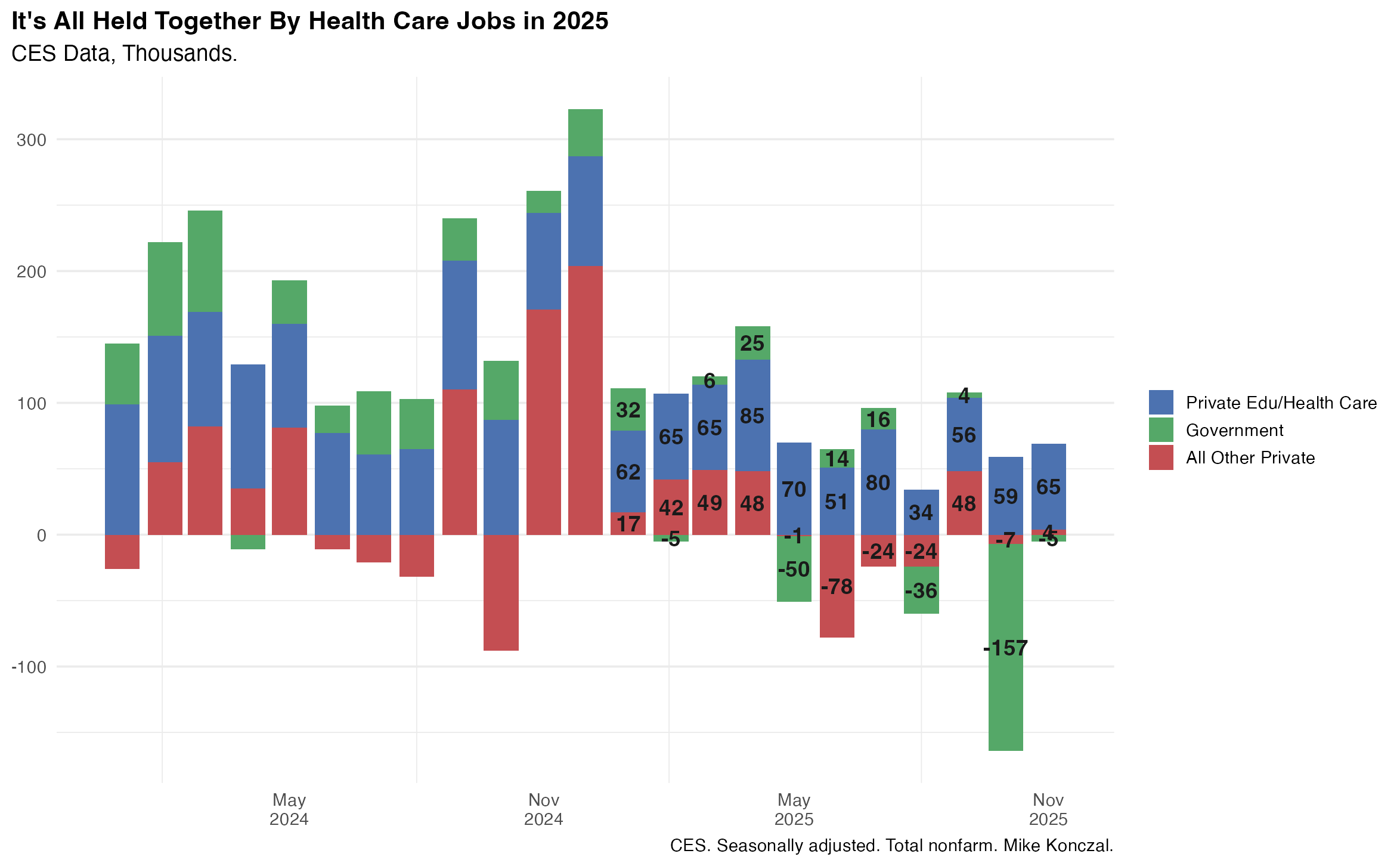
With health care jobs accounting for more than 100 percent of net job growth in some months, clean comparisons become tricky. But looking at private education and health care, the bugaboo of the early second Trump term, in 2019 they were 29% of job growth. For 2023 and 2024 it was 45% and 50% of job growth. In 2025 it has been 113% of job growth. If you include government jobs as well, the share rises from 73% in 2023–24 to 88% in 2025.
Health care continued to do the heavy lifting, while the rest of the labor market collapsed. The promised handoff from government-adjacent employment to private-sector dynamism never materialized.
Second: Tariffs to Reindustrialize
Tariffs were supposed to reindustrialize the country.
The administration argued that higher tariffs would reverse decades of decline in manufacturing and goods-producing employment. This was framed not just as an economic adjustment, but as a historic restoration of American industry.
The Liberation Day tariffs materials made this explicit: “The President’s reciprocal trade agenda means better-paying American jobs making beautiful American-made cars, appliances, and other goods.”

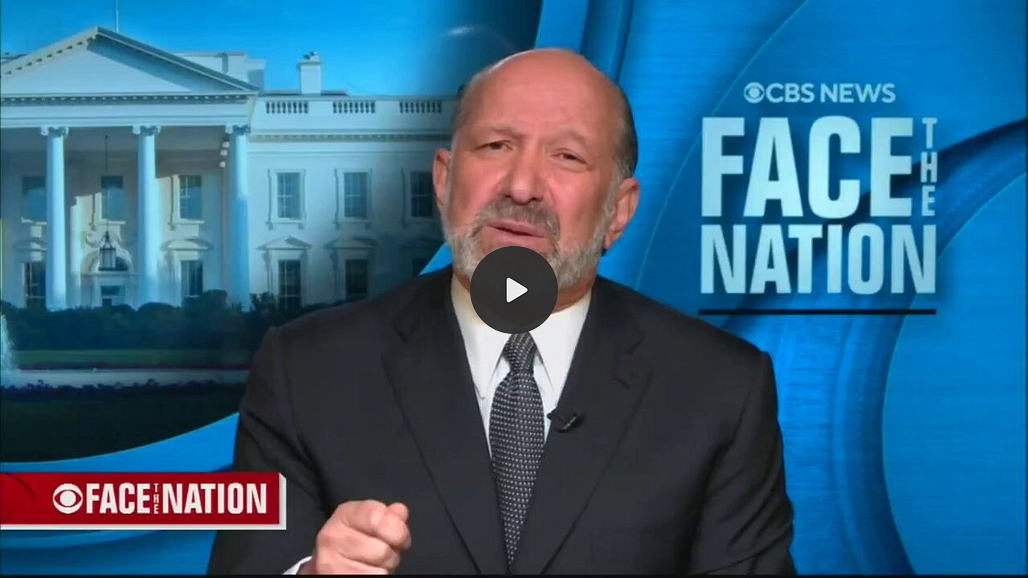
Commerce Secretary Howard Lutnick pushed the vision even further. In a widely circulated interview, he described a coming wave of reshored production:
“[An] army of millions and millions of human beings screwing in little screws to make iPhones -- that kind of thing is going to come to America. It’s going to be automated and great Americans, the tradecraft of America, is going to fix them, is going to work on them [...] it’s going to have the greatest resurgence of jobs in the history of America to work on these high-tech factories, which are all coming to America.”
This was always framed as a longer-term project. But even on its own terms, the question is straightforward: did the administration at least begin to bend the trend lines?
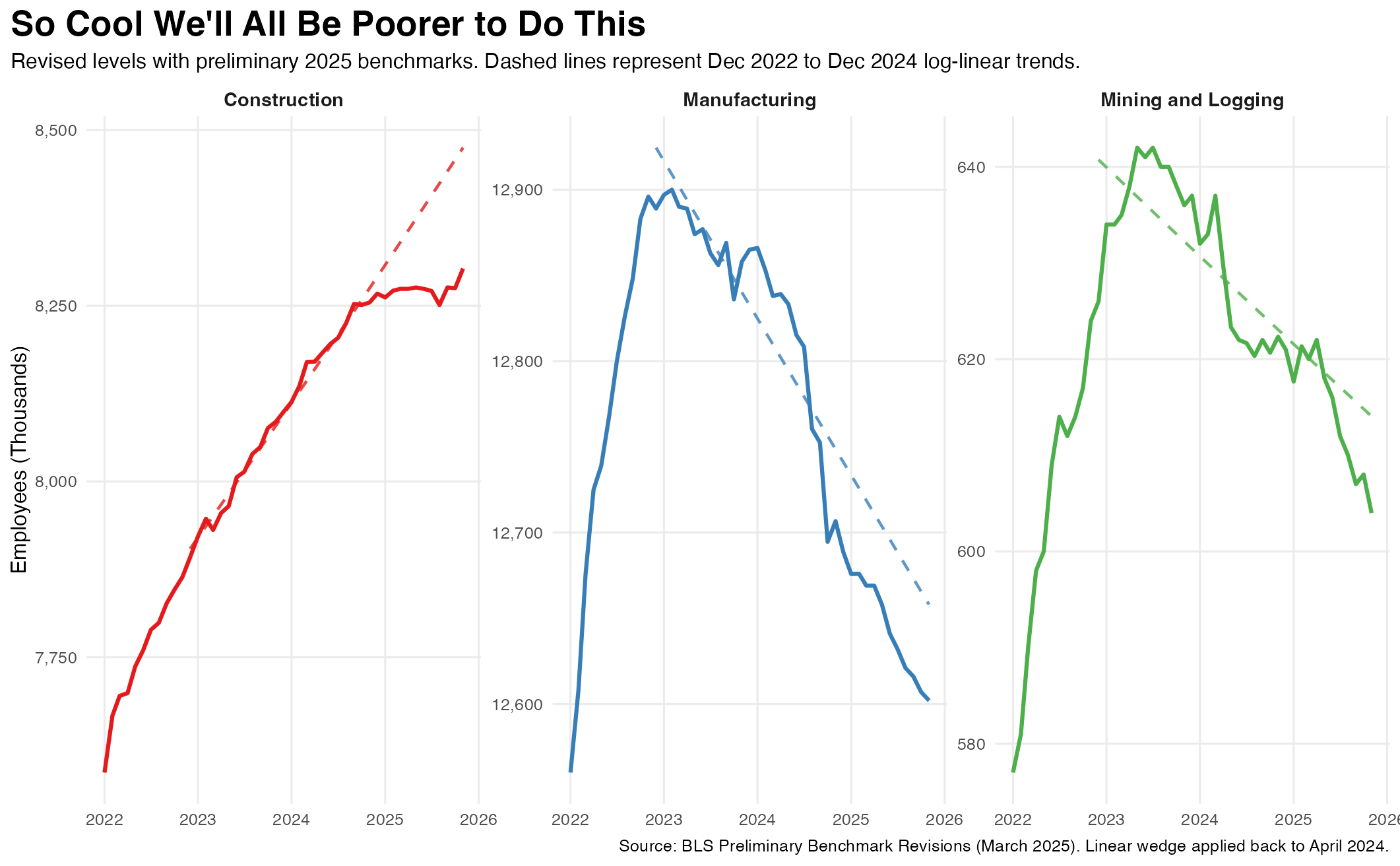
No. That’s not happening.
Here is the data for 2025 with trend lines from December 2022 to 2024. I incorporate the preliminary annual BLS benchmark revision, which aligns monthly payroll estimates with more accurate administrative employment counts, to the earlier data, reducing 2024 job gains. (Data pulls and estimates here.) There is no visible break from the preexisting trajectory, let alone the beginnings of a resurgence. There’s actually further deceleration. This might be for the best, as goods-producing jobs pay, on average, less than private-sector service jobs. But whatever is meant to happen, it hasn’t started yet.
Three: Deportations for Native-Born Benefits
Beyond creating new jobs, the administration argued it could reclaim jobs through mass deportation. By removing foreign-born workers from the labor market, native-born workers would supposedly see their job prospects improve.
Vice President Vance has been especially explicit about this theory. In August, he tweeted: “I was told six months ago that Americans losing jobs and the foreign-born gaining jobs was an irreversible demographic fact.”


As poor Jed Kolko has had to spend 2025 explaining, the reported levels Vance references aren’t correct. But Vance is definitely right about one thing: that pattern isn’t irreversible. Another possibility is that both groups lose at the same time.
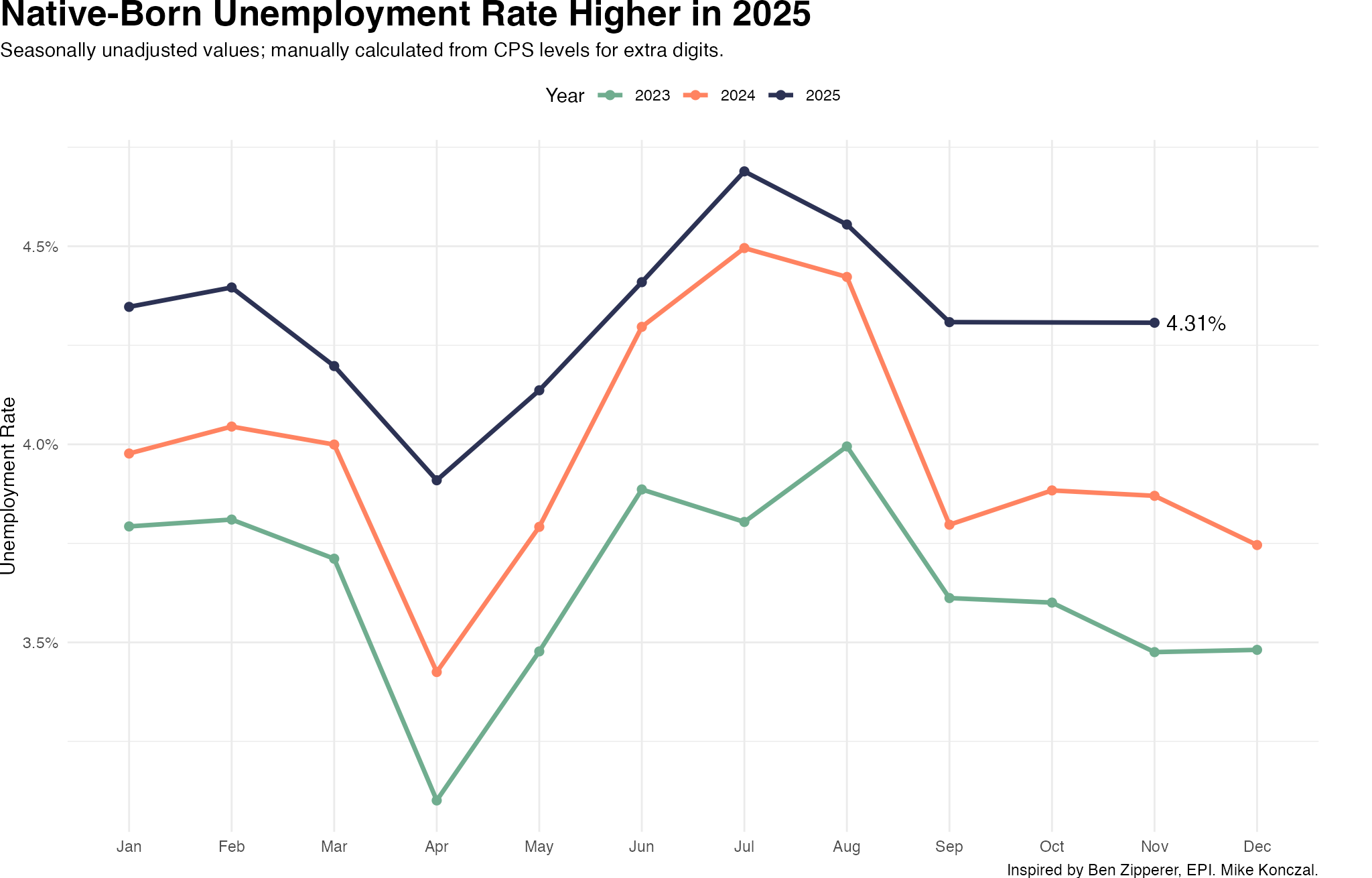
As shown above, it’s a worse year for native-born workers with their unemployment up. The administration believes that employment is a zero-sum competition between groups. But the evidence points to a shared exposure, to both prosperity and, as we’re now experiencing, to rising joblessness amid weakening demand and policy confusion.
Four: The Breadwinner Economy
I think the last is less discussed but is one of the more important things, and that’s the gender theory of MAGA economics. The idea that bringing back manufacturing jobs with high wages for native-born male workers would make them more attractive suitors to women, which in turn would raise the marriage rate, and then fertility rate, is hanging in the background here. I think the gender and culture war aspect of this helps explain why the broader conservative movement is willing to risk tariffs.
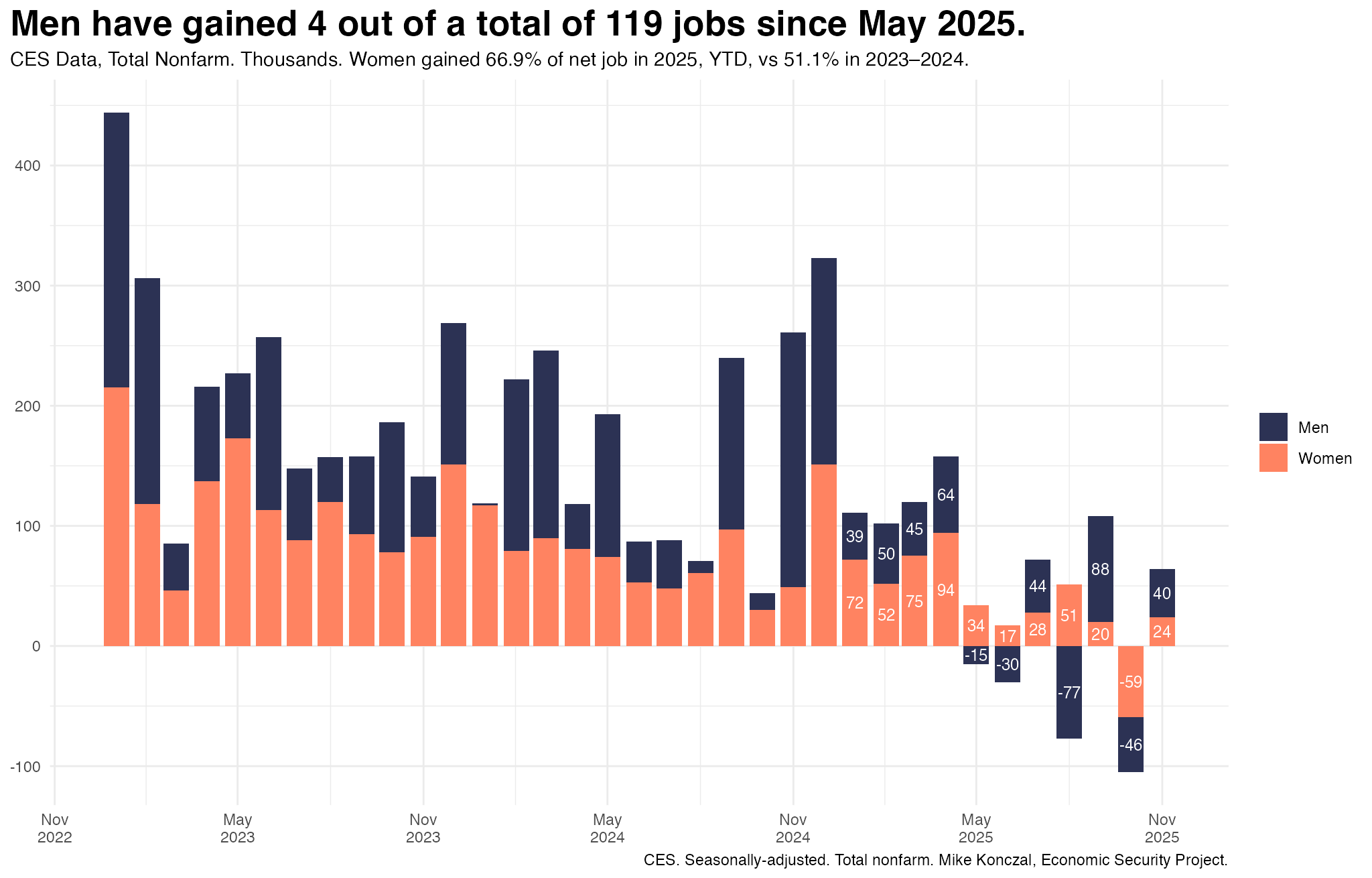
However, that’s not happening. With goods weakening and health care holding the labor market together, Trump has made it a worse environment for male employment. Starting in May, right after Liberation Day, men have gained 4,000 out of a total of 119,000 new jobs. Overall in 2025, women have gained 67% of jobs, compared to 51% in 2023 to 2024. The labor market is moving in the opposite direction of the one this theory requires.
I wish I could tell you that the reason people in their twenties can’t find jobs and the reason many of us are likely to be poorer over the next few years was more sophisticated than “we’re going to turn all the girlbosses into tradwives once they see all the manly men at the USA iPhone-screwing factory.” But I don’t think it is.
The bleak irony is that even after sacrificing real prosperity to chase this 4chan-level political economy, they still won’t achieve their goal. The jobs aren’t coming back, the wages aren’t rising, and family formation won’t be rescued by trying to rewind the labor market to a world that never existed in the first place.
As usual, one is smarter after reading Mike. But riddle me this: why is the labor market weaker? Tariffs definitely in play, but if that was all it was, we could "look through" them as one-time price-level boost, like Fed says on inflation. Less immigration lowers labor supply & demand and lowers breakevens.
Typically, we'd say say C, I, G must be in play. C's a bit damper (and more coming from top) so there's that, but I's stronger (AI), and gov't fiscal impulse pretty neutral and about to go more positive (BBB cuts).
You ask me, Trumpian madness, chaos, etc. just bad for biz (esp smaller biz that imports; see Beige Book anecdotes), but markets generally booming.
Whadya got here??
Reading a different Substack addressing global power comparisons (US-China-Russia), I concluded that all Trump admin officials working to implement Trump's foreign policies are either idiots or sycophants: idiots if they don't know better; sycophants if they do know better but support T's policies because ... loyalty. Reading Mr. Konczal's post today has led me to extend that categorization to all Trumpists who work to implement T's economic policies as well.